Bharat Spice Map to Match Spice Production with Industry Demand
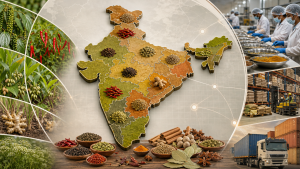
The Spices Board India and the ICAR-Indian Institute of Spices Research (IISR) held a national seminar in Kochi, Kerala, on 9 October 2026 to discuss the proposed Bharat Spice Map. The initiative combines geospatial technology, scientific research and market intelligence to map spice-growing regions, varieties and quality characteristics.
Geospatial Mapping of Spice Crops
The Bharat Spice Map is intended to document the geographical distribution of major spice crops and varieties with specific quality attributes. Geospatial technology uses location-based data to analyse and represent features on maps; Geographic Information Systems (GIS) can combine such data with information on land, climate and crop production. The mapping initiative seeks to support domestic sourcing, reduce import dependence, strengthen the spice value chain and expand exports of value-added products. Its seminar formed part of the Reform Utsav initiative. India grows a range of spices, including pepper, cardamom, turmeric and chilli, across different agro-climatic regions.
Spices Board and Export Development
The Spices Board India is a statutory body under the Union Ministry of Commerce and Industry. It is responsible for the development and promotion of cardamom and other spices, including their export. The ICAR-Indian Institute of Spices Research is part of the Indian Council of Agricultural Research and conducts research on spice crops. At the Bharat Spices Conclave 2026 in April, Union Minister for Food Processing Industries Chirag Paswan called for a shift from bulk supply towards high-value spice products through innovation, quality and value addition. Geographical Indication (GI) tags identify goods associated with a particular geographical origin and recognised qualities or reputation; examples among Indian spices include Malabar Pepper and Alleppey Green Cardamom.
SPICED Scheme and Sustainability Initiative
The Spices Board’s SPICED scheme—Sustainability in Spice Sector through Progressive, Innovative, and Collaborative Interventions for Export Development—has an outlay of ₹422.30 crore and is approved for implementation until FY 2025–26. Its focus areas include raising cardamom productivity, improving post-harvest quality, promoting value-added and GI-tagged spices, and meeting international food-safety standards. Online applications for its development components are scheduled to begin on 1 July 2026. Global ingredient supplier ofi launched its Spice Maps sustainability strategy on 16 December 2025. The strategy sets 2030 targets for six priority spices across major growing regions, including India.
Important Facts for Exams
:
- The Spices Board India functions under the Union Ministry of Commerce and Industry.
- The Indian Council of Agricultural Research is an autonomous organisation under the Union Ministry of Agriculture and Farmers Welfare.
- A GI tag links a product’s qualities or reputation to its geographical origin.
- Post-harvest activities include handling, processing, storage and packaging after a crop is harvested.
The Bharat Spice Map seminar was held in Kochi, Kerala, on 9 October 2026. The SPICED scheme’s stated outlay is ₹422.30 crore.
| Related | |
|---|---|