Agreement Signed to Return Three Tamil Nadu Temple Sculptures
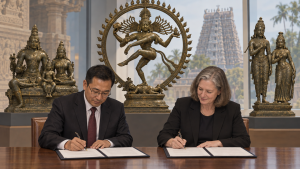
On 27 March 2026, India signed an agreement with the Smithsonian’s National Museum of Asian Art for the return of three sculptures linked to temples in Tamil Nadu.
Sculptures and provenance
The identified sculptures are a ninth-century Shiva Nataraja bronze, a 12th-century Somaskanda sculpture, also known as Shiva and Uma, and a 16th-century depiction of Saint Sundarar with Paravai. Provenance research established that they had been illegally removed from their original temple settings. Photographs in the French Institute of Pondicherry’s Photo Archives documented the sculptures in Tamil Nadu temples between 1956 and 1959.
Signatories and loan arrangement
India’s Deputy Chief of Mission in the United States, Namgya Khampa, and National Museum of Asian Art Director Chase Robinson signed the agreement. The Shiva Nataraja bronze will remain at the Smithsonian on long-term loan for public viewing.
Important Facts for Exams
- Drum symbolism: Nataraja’s upper right hand holds an hourglass-shaped ḍamaru, whose symbolism is linked to the rhythm of creation and time.
- Family composition: In Somaskanda imagery, the infant Skanda appears between Shiva and Uma, depicted dancing ecstatically.
- Hymn collection: Sundarar’s hymns form the seventh volume of the twelve-volume Tirumurai compendium of Shaiva Siddhanta.
| Related | |
|---|---|