ADB and Japan Finance Green Ammonia Plant in Kakinada
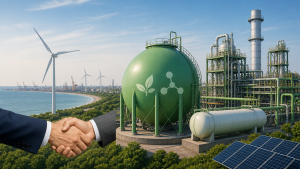
The Asian Development Bank (ADB) and the Government of Japan signed financing agreements on 15 October 2026 with AM Green Ammonia (India) Private Limited for a renewable-powered green ammonia plant in Kakinada, Andhra Pradesh. The project will convert a former natural gas-fuelled ammonia and urea plant into a facility producing ammonia using renewable energy.
Green Ammonia and Its Production
Green ammonia is produced using hydrogen made through water electrolysis powered by renewable electricity, combined with nitrogen separated from air. The two gases are combined through the Haber–Bosch process to produce ammonia, whose chemical formula is NH₃. Conventional ammonia production generally uses fossil fuels to produce hydrogen and is associated with carbon dioxide emissions. Ammonia is used mainly in fertilisers, including urea and ammonium nitrate. It can also be used as a chemical feedstock and as a carrier for hydrogen. The Kakinada project is designed to reduce emissions from industrial ammonia production by using renewable power.
Project Capacity and Financing
The planned capacity is approximately 1.1 million tonnes per annum, with some stated estimates placing the first facility’s capacity at up to 1.5 million tonnes annually. The facility is to be developed in phases; initial commercial production is targeted for 2027 or 2028, while later phases may be commissioned by March 2030. The financing includes a US$100 million loan from Leading Asia’s Private Infrastructure Fund 2 (LEAP 2). The Japan International Cooperation Agency finances LEAP 2, which is administered by ADB. The project is the first investment under the Action for Creating Energy Security for Long-term Resilience (ACCEL), launched by ADB and Japan in May 2026.
Offtake and Emissions
AM Green Ammonia has a long-term offtake agreement with Germany-based Uniper Global Commodities SE. Signed in January 2026, the agreement covers up to 500,000 tonnes of green ammonia annually from 2028. The plant is expected to avoid about 2 million tonnes of carbon dioxide emissions each year when fully operational.
Important Facts for Exams
:
- Ammonia has the chemical formula NH₃ and is a major feedstock for fertiliser production.
- Electrolysis uses electricity to split water into hydrogen and oxygen.
- The Haber–Bosch process synthesises ammonia from hydrogen and nitrogen.
- LEAP 2 is financed by the Japan International Cooperation Agency and administered by ADB.
The Kakinada facility is planned as a phased renewable-powered ammonia project in Andhra Pradesh. Its planned annual capacity is approximately 1.1 million tonnes, with higher estimates of up to 1.5 million tonnes for the first facility.
| Related | |
|---|---|