6th Cycle of Tiger Reserve Evaluation Launched
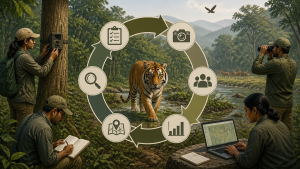
The Inception Workshop for the 6th Cycle of Management Effectiveness Evaluation of Tiger Reserves (MEE-TR) in India was launched in New Delhi on 25 September 2026. The workshop was inaugurated by the Union Minister for Environment, Forest and Climate Change, Bhupender Yadav, and the cycle will assess all 58 tiger reserves in the country.
Management Effectiveness Evaluation of Tiger Reserves
Management Effectiveness Evaluation is a structured assessment of protected area management. The MEE-TR framework in India is organised by the National Tiger Conservation Authority in collaboration with the Wildlife Institute of India.
Framework and Assessment Elements
The MEE framework is adapted from the IUCN World Commission on Protected Areas Framework. It assesses six elements: Context, Planning, Inputs, Processes, Outputs, and Outcomes. These elements are used to examine management conditions, resources, implementation, and results in tiger reserves.
6th Cycle Features and Coverage
The Technical Manual for MEE-TR 2026 was released during the inaugural session. A separate evaluation criterion on Solid Waste Management has been added for waste generated from forest chowkis, tourism activities, and wildlife rescue centres.
India completed five earlier MEE cycles in 2006, 2010, 2014, 2018, and 2022. These cycles covered 28, 39, 43, 50, and 51 tiger reserves, respectively.
Important Facts for Exams
- Project Tiger was launched in India in 1973 as a centrally sponsored scheme for tiger conservation.
- The National Tiger Conservation Authority was constituted under the Wildlife (Protection) Act, 1972.
- India has 58 tiger reserves under the current MEE-TR cycle.
- The IUCN World Commission on Protected Areas develops global guidance for protected area management.
Tiger Reserve Administration
Tiger reserves in India are notified under the Wildlife (Protection) Act, 1972. They include core and buffer areas, and their management involves habitat protection, anti-poaching measures, and regulated tourism.
| Related | |
|---|---|