West Bengal plans direct sowing of mangrove propagules across 600 hectares in the Sundarbans
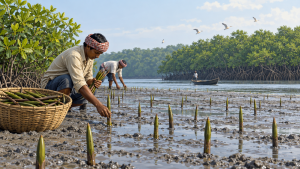
In October 2026, the South 24 Parganas Forest Division was reported to have identified about 600 hectares in the Sundarbans for a planned direct-sowing mangrove initiative.
Planned sowing and locations
The plan is to sow about one crore mangrove propagules, with work expected to begin in November 2026. Reported locations include areas in Kultali, Mathurapur-II, Basanti, Kakdwip, Sagar and Namkhana blocks. Direct sowing is intended to avoid the time required to raise nursery saplings before planting. The figures are reported estimates; sowing had not been reported as completed.
Important Facts for Exams
- Sediment capture: In the Sundarbans, mangrove fauna on intertidal mudflats trap and hold sediment, helping create a substrate for mangrove seeds.
- Viviparous propagules: In several mangrove genera, seeds germinate on the parent tree (vivipary), producing elongated propagules that detach and disperse with tides.
- Contrasting salt strategies: Mangrove species manage salt differently: Rhizophora largely excludes it at root surfaces, whereas Avicennia can excrete absorbed salts through leaf glands.
- Tidal dispersal: Many mangrove propagules are hydrochorous: tidal currents transport them, and successful establishment depends on stranding in suitable intertidal habitat.
Category: West Bengal
Originally written on
October 30, 2026
and last modified on
November 20, 2026.
| Related | |
|---|---|