Uttar Pradesh Current Affairs – April 2026
Uttar Pradesh Politics & Governance
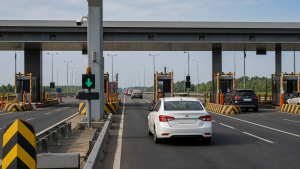
Revised toll rates take effect on Uttar Pradesh expressways and highways
1 April 2026
Revised toll rates took effect on 1 April on four Uttar Pradesh expressways: Agra-Lucknow, Purvanchal, Bundelkhand and Gorakhpur Link. Rates vary by route and vehicle class; for a full-route trip, a car or light motor vehicle is charged ₹675 on Agra-Lucknow and ₹295 on Gorakhpur Link, while the listed rates for those vehicles on Purvanchal and Bundelkhand were unchanged.
Toll rates also rose on the Delhi–Meerut Expressway and NH-9. On the Delhi–Meerut Expressway, the car, jeep or van toll increased from ₹170 to ₹175.
Key Facts
- UPEIDA developed Purvanchal Expressway , a six-lane controlled-access route connecting Lucknow district with Ghazipur.
High Court orders fresh decision on MGNREGA coordinators’ honorarium proposal
1 April 2026
The Allahabad High Court quashed the Uttar Pradesh government’s rejection of a proposal for an outstanding honorarium increase for MGNREGA district and block social-audit coordinators. It directed the state government to consider the Social Audit Directorate’s relevant material and issue a fresh, reasoned order within three weeks.
Key Facts
- MGNREGA designated social audits as a key mechanism for public vigilance and accountability.
Uttar Pradesh launches School Chalo enrolment campaign for 2026–27
1 April 2026
Uttar Pradesh launched the School Chalo Abhiyan for the 2026–27 academic session on 1 April, with a 15-day enrolment and awareness drive. The campaign aims to encourage families to enrol children and prevent them from remaining out of school, with activities planned at school, block and district levels.
In Prayagraj, the campaign included plans to register children up to three years old at Anganwadi centres and facilitate school admission for older children, including those progressing after classes 5, 8 and 10.
Key Facts
- Anganwadi centres provide rural childcare through the Integrated Child Development Services programme, which was launched to combat child hunger and malnutrition.
Uttar Pradesh launches school-vehicle safety portal and inspection drive
1 April 2026
Uttar Pradesh launched the UP Integrated School Vehicle Management Portal (UP-ISVMP) on 1 April alongside a statewide school-vehicle fitness inspection drive scheduled for 1–15 April. The portal provides online vehicle registration and monitoring of documents and compliance; its “Know Your Bus” feature allows parents to check vehicle details, including fitness status, permits, pollution certificates and insurance.
The inspection drive was to check vehicles’ fitness, registration, permits, insurance, pollution certificates and physical condition. QR-code installation on school vehicles was planned to give parents access to vehicle and driver information.
Key Facts
- The Motor Vehicles Act regulates vehicle registration, permits, insurance, traffic rules, liability, offences and penalties.
Prepaid mode made optional for smart-meter consumers
1 April 2026
A Central Electricity Authority notification made prepaid mode optional for smart meters in areas with communication networks, allowing consumers to choose prepaid or postpaid mode. The report gave Uttar Pradesh’s installed total as more than 78 lakh smart meters, including about 70 lakh prepaid meters.
Key Facts
- The Electricity Act, 2003 includes consumer protection among its objectives.
Revised minimum wages take effect across Uttar Pradesh
1 April 2026
Revised monthly minimum-wage rates for Uttar Pradesh workers took effect from 1 April 2026, with rates set by district group and skill category. In Gautam Buddha Nagar and Ghaziabad, the monthly rates are ₹13,690 for unskilled, ₹15,059 for semi-skilled and ₹16,868 for skilled workers; the other municipal-corporation districts and remaining districts have separate rates.
Key Facts
- A statutory minimum wage is a legal pay floor: employers cannot lawfully pay covered workers less.
High Court clarifies parents’ financial capacity in child-maintenance case
1 April 2026
The Allahabad High Court ruled in a child-maintenance case that a mother’s employment does not by itself remove the father’s responsibility to provide for the child. It said the child need not necessarily implead the mother in proceedings under Section 144 of the Bharatiya Nagarik Suraksha Sanhita, while the court deciding maintenance should consider both parents’ financial capacity.
Key Facts
- The BNSS is India’s principal procedural law governing administration of criminal law.
High Court addresses effective date of divorce in maintenance case
1 April 2026
The Allahabad High Court held in a maintenance case that, under Mohammedan law as applied in the matter, the divorce took effect on the date it ...
| Related | |
|---|---|