Page-4 of Topic: Political Science

Nature of the State in Capitalist Societies [UGC-NTA NET Political Science Notes]
The state is a fundamental political entity that operates within defined boundaries, possessing a structured government and sovereignty. In capitalist societies, the nature and role of the state...
Development and Democracy – UGC-NTA NET Political Science
Development and democracy are two interrelated concepts that shape the political landscape of nations. Definitions Development encompasses several dimensions: Economic growth – Increase in a country’s output of...
Comparative Political Analysis – Colonialism and Decolonization [UGC-NTA NET Political Science Notes]
Colonialism and decolonization represent themes in political science, particularly in the study of comparative politics. Colonialism is the practice of domination by one group over another, often leading...
Human Rights in Contemporary Challenges
Human rights are fundamental rights inherent to all human beings. They are universal, inalienable, and indivisible. Definition of Human Rights Human rights are the basic rights and freedoms...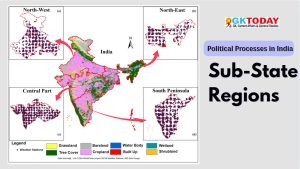
Sub-State Regions in India – UGC-NTA NET Political Science
Sub-state regions in India represent areas within states that possess distinct cultural, linguistic, or ethnic identities. These regions often seek greater autonomy or recognition within the larger framework...
Emerging Trends in Federalism in India [UGC-NTA Net Political Science]
Federalism in India is a complex and evolving system, characterised by the distribution of powers between the central government and state governments. This structure has been shaped by...
Checks and Balances in India – UGC-NTA NET Political Science
Checks and balances are fundamental to the functioning of democracy in India. They ensure that power is distributed among various branches of government, preventing any single entity from...
Anti-Colonial Struggles [UGC-NTA Net Political Science]
Anti-colonial struggles are very important movements aimed at ending colonial rule and achieving independence. These movements often arise from the desire for self-determination and resistance against foreign domination....
Constitutional Amendments in India – UGC-NTA NET Political Science
The Constitution of India is a living document that evolves with the changing needs of society. Constitutional amendments are vital for adapting the framework of governance. They ensure...
International Relations – WTO Study Notes
The World Trade Organization (WTO) is a vital institution in international relations and political economy. Established to regulate international trade, it plays important role in promoting free trade...
Ideological Moorings of the Constituent Assembly of India [UGC-NTA Net Political Science]
The Constituent Assembly of India, formed in 1946, was a very important body in shaping the nation’s constitutional framework. Tasked with drafting the Constitution, it brought together representatives...