Telangana Unveils Life Sciences Policy 2026–30 at Davos
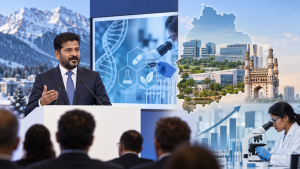
On 21 January 2026, Telangana Chief Minister A. Revanth Reddy unveiled the state’s Next-Gen Life Sciences Policy 2026–30 at the World Economic Forum annual meeting in Davos.
Targets and proposed measures
The policy aims to attract $25 billion in investment and create five lakh (500,000) jobs over five years, with the goal of placing Telangana among the world’s top five life sciences clusters by 2030. Proposed measures include establishing ten pharma villages and creating a dedicated Life Sciences Innovation Fund, scalable up to ₹1,000 crore.
Important Facts for Exams
- Genome Valley cluster: Hyderabad’s Genome Valley is widely identified as India’s first organised life-sciences research and development cluster, bringing research firms together with supporting infrastructure.
- Industrial approvals: Telangana’s TS-iPASS system provides time-bound, single-window industrial approvals and includes deemed approval when departments miss statutory deadlines.
- Biotechnology startup funding: BIRAC, established by India’s Department of Biotechnology, offers Biotechnology Ignition Grants to support early-stage biotechnology ideas through proof-of-concept funding.
- Shared pharmaceutical infrastructure: Separately, India’s bulk drug parks scheme supports shared facilities such as solvent recovery, common effluent treatment and testing laboratories for manufacturers.
Originally written on
January 21, 2026
and last modified on
November 19, 2026.
| Related | |
|---|---|