Telangana Introduces QR-Code HIV Risk Assessment
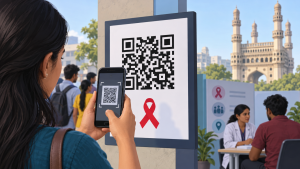
Telangana launched a QR code-based HIV risk assessment service on 12 August 2026, allowing users to assess their potential risk and seek follow-up support.
How the assessment works
Users scan the QR code, select a preferred language, provide basic demographic information such as state, district, age and gender, and answer a series of questions. The service assesses potential HIV risk but does not diagnose HIV; confirmation requires an HIV test. People identified as potentially at risk can be directed to nearby testing centres or counselling services. The initiative aims to provide a confidential, convenient way to assess risk and seek support.
Important Facts for Exams
- QR encoding modes: QR codes encode data using four standard modes: numeric, alphanumeric, byte or binary, and kanji.
- QR scanning mechanism: A QR code is captured by a two-dimensional image sensor and analysed digitally, unlike a one-dimensional barcode scanned by a narrow light beam.
- HIV testing safeguards: Stated safeguards for HIV testing include confidentiality, informed consent, and counselling for people who receive a positive result.
Category: Telangana
Originally written on
August 12, 2026
and last modified on
November 20, 2026.
| Related | |
|---|---|