Rohtas scientist tests direct-seeded rice cultivation
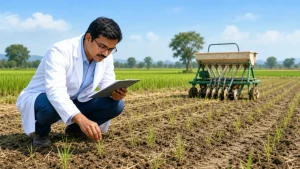
Agricultural scientist Dr Ramakant Singh grew rice in a dry field in Rohtas by sowing seeds directly, without raising a nursery or transplanting seedlings. He used a multi-crop machine, and the method required about two kilograms of seed per acre.
A trial at Krishi Vigyan Kendra, Bikramganj, compared direct sowing with conventional cultivation using the same rice variety at about the same time. The harvested crops showed no significant difference. The method may reduce the labour and cost involved in nursery preparation and transplanting, but weed control is important and may require two herbicide applications, depending on crop conditions.
For the Sabour Mansoori variety, Dr Singh estimated a yield of about 18–20 quintals per bigha with the method, provided weeds are managed.
Notable Points
- Direct-seeded rice challenges: In direct-seeded rice, water in flooded fields acts as a natural barrier to weeds. Without it, weeds can grow alongside rice and reduce yields. Precise seed placement is also needed for suitable plant density and uniform growth; drill seeders and laser-assisted land levelling are identified as technical measures.
| Related | |
|---|---|