Rajasthan Assembly passes bills to remove two-child bar for local elections
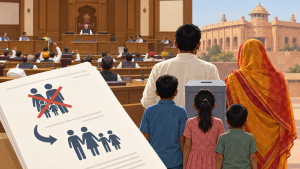
The Rajasthan Assembly passed amendments to the state’s Panchayati Raj and Municipal Acts on March 9 and 10, 2026. The bills provide for removing the two-child disqualification for candidates contesting local elections.
Eligibility for local elections
The Panchayati Raj Amendment Bill, 2026, was passed on March 9, while the Rajasthan Municipal (Amendment) Bill, 2026, was passed on March 10. The amendments would allow people with more than two children to contest elections to panchayats, municipalities, municipal councils and municipal corporations. The municipal amendment also provides for removing leprosy as a disqualifying disease for municipal elections. Passage alone does not establish that either Bill had taken effect.
Background to the amendments
The two-child rule was introduced around 1995 by the government of Bhairon Singh Shekhawat. The Rajasthan government cited a decline in the total fertility rate and greater awareness of family planning as reasons for removing it.
Important Facts for Exams
- Three-tier structure: Panchayati Raj comprises village-level Gram Panchayats, block-level Panchayat Samitis and district-level Zila Parishads.
- Election cycle: Panchayati Raj Institutions serve five-year terms, with elections conducted by the respective State Election Commission.
- Representation safeguards: Panchayats provide for Scheduled Caste and Scheduled Tribe representation in population proportion, alongside a minimum one-third reservation for women.
- Policy mechanisms: Two-child policies have used either a family-size cap or a restriction of government subsidies to the first two children.
| Related | |
|---|---|