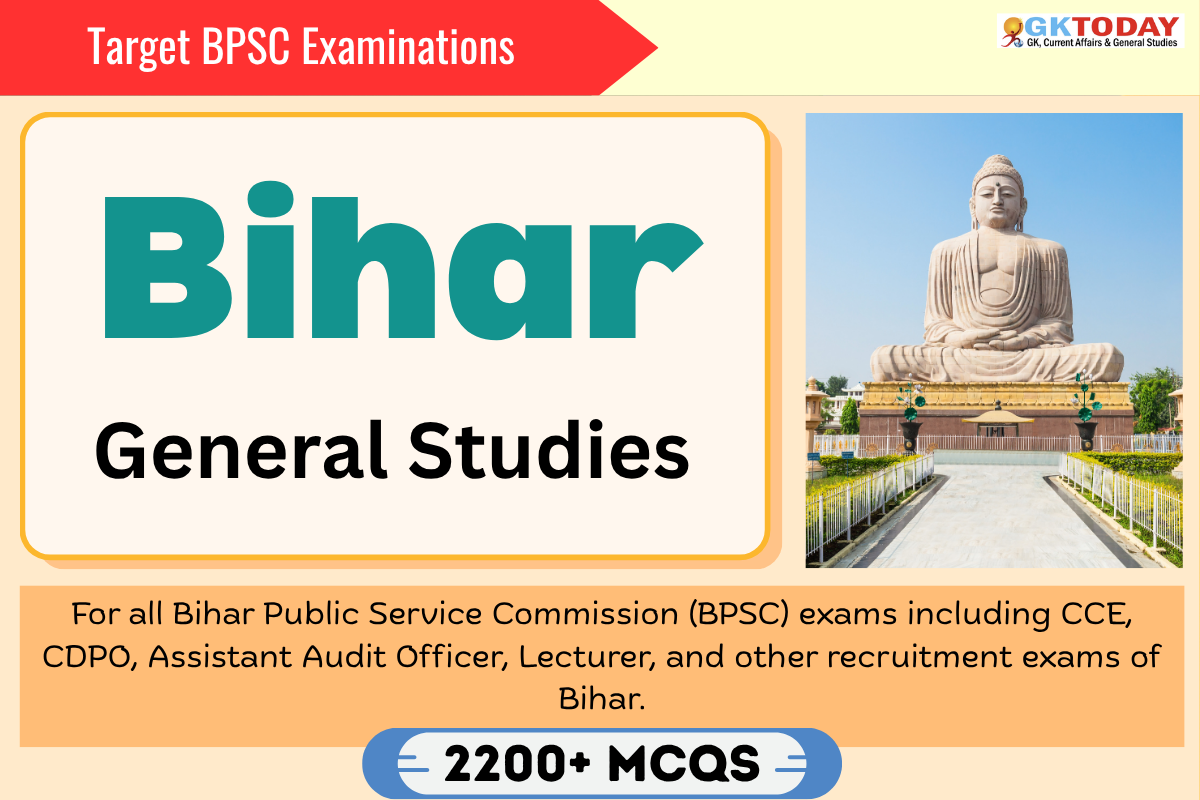
States PCS: Bihar GK for BPSC and other Bihar PCS Exams
For all Bihar Public Service Commission (BPSC) exams including 67th-70th CCE, CDPO, Assistant Audit Officer, Lecturer, and other recruitment exams of Bihar.
1. Under which sultan of delhi, Malik Ibrahim Bayu reigned as Governor of Bihar?
[A] Muhammad Shah Tughlaq
[B] Firoz Shah Tughlaq
[C] Alauddin Khilji
[D] Ulugh khan
Show Answer
Correct Answer: A [Muhammad Shah Tughlaq]
Notes:
Malik Ibrahim Bayu was a Ghazni born fighter of 14th century who defeated the local tribal Kols and Raja Birthal and became the Governor of the region later under Muhammad bin Tughlaq. He was also a sufi saint and his tomb is located in Bihar Sharif.
2. Which of the following waterfalls is located in Bihar?
[A] Dudhsagar Waterfalls
[B] Kakolat Waterfalls
[C] Jog Falls
[D] Kempty Falls
Show Answer
Correct Answer: B [Kakolat Waterfalls]
Notes:
Kakolat Waterfalls is in Nawada district, Bihar, and is notable for its height of about 160 feet and historical significance. The area is surrounded by lush green forests.
3. What is the traditional Applique works of Bihar?
[A] Chandua
[B] Khatwa
[C] Chakyar Koothu
[D] Ottamthullal
Show Answer
Correct Answer: B [Khatwa]
Notes:
Khatwa is Bihar’s traditional applique work, involving cutting one fabric and stitching the pieces onto another to create decorative patterns, mainly for tents, canopies, and shamianas using colorful fabrics and mirrors.
4. Which God is worshipped during the Shravani Mela?
[A] Lord Hanuman
[B] Lord Buddha
[C] Lord Shiva
[D] Lord Brahma
Show Answer
Correct Answer: C [Lord Shiva]
Notes:
Lord Shiva is worshipped during the Shravani Mela. It is held every year in the Hindu month of Shravan (the lunar month of July-August). Shravani Mela is a month-long ritual observance which is held along a 108 km route linking the towns of Sultanganj and Deoghar.
5. Who is credited with evolving the traditional Bideshia style, originally started by Bhikari Thakur, for modern Indian theatre?
[A] Arun Kamal
[B] Usha Kiran Khan
[C] Satish Anand
[D] Madhukar Singh
Show Answer
Correct Answer: C [Satish Anand]
Notes:
Satish Anand evolved the Bideshia style in 1984, blending indigenous Bihari theatrical traditions for modern Indian theatre. The style was originally started by Bhikari Thakur, known as the “Shakespeare of Bhojpuri.”
6. Who was known as “Janakavi—the People’s Poet”?
[A] Vidyapati
[B] Ramdhari Singh Dinkar
[C] Nagarjun
[D] Swami Sahajanand Saraswati
Show Answer
Correct Answer: C [Nagarjun ]
Notes:
Nagarjun was known as “Janakavi—the People’s Poet”. He was a major Hindi and Maithili poet who has also penned a number of novels, short stories, literary biographies and travelogues. He often wrote on contemporary social and political issues. Besides these accepted subjects of poetry, Nagarjun found poetic beauty in unconventional subjects like a series of poems on a full-grown jackfruit etc. Because of the breadth of his poetry, Nagarjun is considered the only Hindi poet after Tulsidas to have an audience ranging from the rural sections of society to the elite. Nagarjun was given the Sahitya Akademi Award in 1969 for his historic book Patarheen Nagna Gachh and the ‘Bharat Bharati Award’ by the Uttar Pradesh government for his literary contributions in 1983. He was also honoured by the Sahitya Akademi Fellowship, India’s highest literary award for lifetime achievement in 1994.
7. Who was the first Indian principal of the Government Sanskrit College in Varanasi?
[A] Bhikari Thakur
[B] Khuda Bakhsh
[C] Phanishwar Nath ‘Renu’
[D] Ganganath Jha
Show Answer
Correct Answer: D [Ganganath Jha ]
Notes:
Ganganath Jha was the first Indian principal of the Government Sanskrit College in Varanasi. Ganganath Jha was born in a Maithil Brahmin family of the Sarisab Pahi village in the Madhubani district of Bihar. He was a scholar of Sanskrit, Indian Philosophy and Buddhist Philosophy. At the age of 24, he was appointed librarian of the Darbhanga state by its Maharaja. In 1902, he was appointed Professor of Sanskrit at Muir College in Allahabad. In 1918, he went to Varanasi to become the first Indian principal of the Government Sanskrit College.
8. Who was the first woman in Bihar to gain a Master’s degrees?
[A] Ram Dulari Sinha
[B] Meira Kumar
[C] Manorama Pandey
[D] Misa Bharti
Show Answer
Correct Answer: A [Ram Dulari Sinha]
Notes:
Ram Dulari Sinha was the first woman in Bihar to gain a Master’s degrees. She was also the first woman from Bihar to be appointed as Governor. As a Parliamentarian, she is amongst few of those Parliamentarian’s who got the opportunity to work with the first three Prime Ministers of India Jawahar Lal Nehru, Lal Bahadur Shastri and Indira Gandhi.
9. Who was the chairman of the Welcome Committee in the Bankipur Congress Conference?
[A] Dr. Rajendra Prasad
[B] Raj Kumar Shukla
[C] Mahatma Gandhi
[D] Maulana Mazrul Haque
Show Answer
Correct Answer: D [Maulana Mazrul Haque]
Notes:
Maulana Mazrul Haque was the chairman of the Welcome Committee in the Bankipur Congress Conference.
Maulana Mazharul Haque was born in Patna. He was an educationist, a lawyer, independence activist and a freedom fighter of the Indian National Movement. He constructed a house in Faridpur, Siwan, Bihar and named it Ashiyana. In the 18th Century, Ashiyana was a center for Freedom Fighters and it was visited by many nationalists, including Dr. Rajendra Prasad and Mahatma Gandhi.
10. Which district is known as Rice bowl of Bihar?
[A] Darbhanga
[B] Bhagalpur
[C] Gaya
[D] Rohtas
Show Answer
Correct Answer: D [Rohtas]
Notes:
The production of Paddy is the highest in Rohtas district. Rohtas district is also known as Rice bowl of Bihar. It has a rice mill cluster of 40 units.
Rohtas district came into existence when Shahabad District was bifurcated into Bhojpur & Rohtas in 1972. Administrative headquarter of the district is Sasaram.