PSLV-C62 Fails to Place Satellites in Intended Orbit
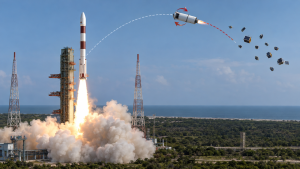
The PSLV-C62/EOS-N1 mission lifted off from the First Launch Pad at Satish Dhawan Space Centre, Sriharikota, Andhra Pradesh, on 12 January 2026 at 10:18:30 IST. It was the 64th flight of the Polar Satellite Launch Vehicle (PSLV) and the Indian Space Research Organisation’s first space mission of 2026.
Third-stage anomaly disrupts the mission
The PSLV’s first two stages performed nominally, but an anomaly occurred during the third stage. ISRO Chairman V. Narayanan said a disturbance in the vehicle’s roll rates near the end of that stage was followed by a flight-path deviation. As a result, the primary satellite, EOS-N1, and 15 co-passenger satellites were not placed in their intended orbit.
Commercial mission carried 15 co-passenger payloads
The launch was the ninth dedicated commercial mission undertaken by NewSpace India Limited (NSIL), ISRO’s commercial arm. EOS-N1 was designed as a hyperspectral Earth observation satellite for strategic and civilian use; the 15 co-passengers came from domestic and international customers. They included the KID (Kestrel Initial Demonstrator) capsule, which was planned for ballistic re-entry into Earth’s atmosphere. Telemetry data from the capsule was successfully received.
Important Facts for Exams
- Third-stage steering: PSLV’s third stage uses a gimballed, flex-bearing-seal nozzle with up to ±2° thrust-vector movement to control pitch and yaw.
- Roll control: During powered and combined-coasting flight, PSLV’s fourth-stage reaction-control system provides roll control while the spent third stage remains attached.
- KID recovery design: The KID demonstrator had neither onboard propulsion nor parachutes and was not intended to be recovered after landing.
- EOS-N1 applications: EOS-N1 was intended for civilian monitoring of agriculture, urban mapping and the environment, alongside strategic defence use.
| Related | |
|---|---|