Opium Policy 2026–27 Expands Eligibility in Rajasthan
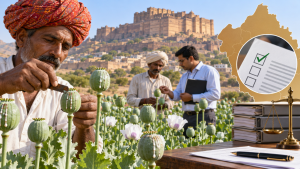
The Centre’s Opium Policy 2026–27 was announced by the Ministry of Finance’s Department of Revenue on 23 October 2026. It expands eligibility for opium cultivation licences in Rajasthan and other states, and covers the crop year from 1 October 2026 to 30 September 2027.
Eligibility and licensing criteria
In Rajasthan, 4,261 additional cultivators are expected to become eligible for licences. Under the lancing method, applicants must have recorded an average morphine yield of at least 4.4 kg per hectare in the preceding crop year, 2025–26.
Land and cultivation rules
Eligible cultivators may lease land from others to meet the prescribed cultivation-area requirement. The policy permits condonation of excess cultivation up to 5% of the licensed area. The Central Bureau of Narcotics website provides unit-wise lists of eligible and ineligible cultivators for the 2026–27 crop year, including for Rajasthan.
Important Facts for Exams
- Cultivation oversight: District Opium Officers handle cultivator licensing, field measurement and opium collection; range Sub-Inspectors measure cultivation area and maintain cultivator records.
- Cultivation and enforcement roles: CBN divisions separate cultivation supervision from preventive enforcement: District Opium Officers oversee cultivation, while Preventive and Intelligence Cells handle enforcement functions.
- Notified cultivation areas: India's licensed opium-poppy cultivation is confined to areas notified by the Central Government under the Narcotic Drugs and Psychotropic Substances Rules, 1985.
- Alternative harvesting system: Concentrate of Poppy Straw cultivation harvests capsules for alkaloid extraction, unlike lancing, which collects latex from incised poppy capsules.
| Related | |
|---|---|