Odisha Current Affairs – June 2026
Odisha Politics & Governance
Odisha and Union ministers discuss mining-area development and clearances
1 June 2026
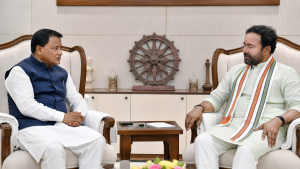
Odisha Chief Minister Mohan Charan Majhi met Union Coal and Mines Minister G. Kishan Reddy in Bhubaneswar to discuss mining-sector growth and development in mineral areas. Majhi sought faster forest and environmental clearances for auctioned blocks, along with improved rail and port infrastructure.
The meeting stressed coordinating government schemes, District Mineral Foundation funds and company CSR spending in mining areas. Majhi proposed a framework for filling abandoned coal mines with fly ash, while Reddy suggested a high-level meeting involving the relevant ministries and the state to address sectoral issues.
Key Facts
- Corporate social responsibility (CSR) can include company support for community development and public-benefit initiatives.
Gajapati drinking-water project remains incomplete; contractor fined ₹25 lakh
1 June 2026
A ₹134.82-crore drinking-water project intended to serve 103 villages in Gajapati district’s Kashinagar and Gumma blocks remained incomplete, with water reaching six villages at the time of reporting. The contractor was fined ₹25 lakh for delay.
The district drinking-water executive engineer set 15 June as the target for supplying all 103 villages and warned of further action if the target was missed.
Rayagada Railway Division becomes operational
1 June 2026
The Rayagada Railway Division under East Coast Railway became operational on 1 June, with its headquarters in Rayagada and a reported network of about 696 km. Its jurisdiction includes the Koraput–Singapur Road, Kottavalasa–Kirandul, Kuneru–Therubali and Gunupur–Paralakhemundi routes, strengthening railway administration in southern Odisha.
Key Facts
- Rayagada Division takes over part of the former Waltair Division within East Coast Railway, giving the zone a dedicated division for this area.
Odisha’s government EV procurement rule takes effect
1 June 2026
Odisha’s Finance Department rule requiring electric vehicles for government replacement purchases took effect on 1 June. A replacement EV may be purchased only after the existing vehicle reaches the end of its service life and is scrapped or decommissioned, with Finance Department approval. Purchase ceilings are ₹30 lakh for the Governor, Chief Minister, High Court judges and ministers; ₹25 lakh for specified senior officials; and ₹20 lakh for district judges, collectors and superintendents of police.
Key Facts
- Electric vehicles can reduce tailpipe greenhouse-gas and air-pollutant emissions and dependence on fossil fuels, although overall emissions depend on electricity generation.
Odisha introduces revised DMF fund-sharing rules
1 June 2026
Odisha’s revised District Mineral Foundation (DMF) fund-sharing mechanism took effect on 1 June 2026. It allocates 70% of funds for areas directly affected by mining, defined as within 15 kilometres of a mine, and 30% for indirectly affected areas 15–25 kilometres away; areas beyond 25 kilometres are excluded.
Where a mine’s affected area extends across districts, the district containing the mine will collect the DMF funds and distribute shares to affected districts according to the geographical extent of those areas. The Odisha Space Applications Centre (ORSAC) will identify affected areas, with coordination by the Director of Mines and Geology.
Odisha mandates hired electric vehicles for government offices
1 June 2026
Odisha’s Finance Department made hired electric vehicles mandatory for state government offices from 1 June 2026, for a two-year period. The order also covers state public-sector undertakings, educational institutions, universities and societies, and sets monthly rental ceilings by user category. Charging costs are additional, with a separate per-kilometre payment provided for.
Key Facts
- Electric vehicles can reduce tailpipe greenhouse-gas and air-pollutant emissions and lessen dependence on fossil fuels.
Odisha formalises higher reservations for technical-course admissions
2 June 2026
Odisha issued a memorandum setting higher reservation rates for ST, SC and SEBC students in specified technical and professional courses from the 2026–27 academic year. The rates are 22.5% for ST students, 16.25% for SC students and 11.25% for SEBC students.
The policy covers courses including engineering, medicine, nursing, pharmacy, agriculture and allied sciences at state universities and affiliated institutions, as well as ITIs and polytechnics.
Key Facts
- Reservation is an affirmative-action measure intended to improve disadvantaged groups’ access to higher education and social integration.
Odisha reviews 48 highway projects and implementation bottlenecks
2 June 2026
Odisha Works Minister Prithviraj Harichandan reviewed 48 highway projects valued at more than ₹50 crore each, focusing on progress and implementation bottlenecks. Officials discussed land acquisition, forest clearances ...
| Related | |
|---|---|