Why are minilateral groupings like the Colombo Security Conclave becoming preferred vehicles for maritime diplomacy in the Indian Ocean? Critically discuss.
Minilateral groupings such as the Colombo Security Conclave (CSC) are gaining ground in the Indian Ocean because maritime threats are now fast-moving, cross-border and highly specific. Smaller, issue-based forums can deliver quicker cooperation than broad regional bodies that often struggle with consensus.
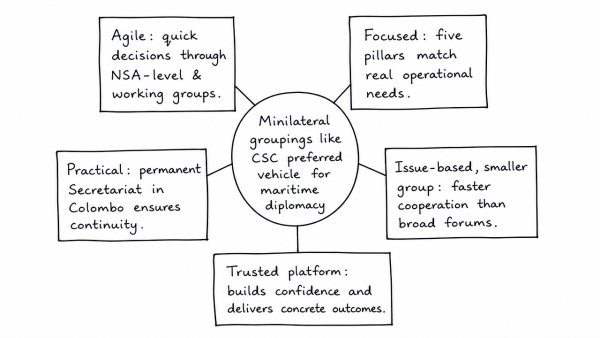
- Why they are preferred
- They are agile: the CSC can take decisions quickly through NSA-level and working group meetings.
- They are focused: the five pillars of cooperation — maritime security, counter-terrorism, trafficking, cyber-security and HADR — match real operational needs.
- They are practical: the permanent Secretariat in Colombo and the 2025-26 roadmap give continuity and follow-up.
- They reflect shared threat perceptions: piracy, IUU fishing, narcotics trafficking, maritime terrorism and climate-linked disasters affect littoral states in similar ways.
- They allow coalition-building among states that want cooperation without the rigidity of larger forums.
- Strategic value
- For India and smaller Indian Ocean states, minilaterals support strategic autonomy and niche diplomacy.
- They help build trust, improve domain awareness and strengthen interoperability in a region shaped by great-power competition.
- Critical concerns
- Minilaterals can be exclusionary and may sideline wider regional voices.
- They may fragment the Indian Ocean architecture if too many overlapping groupings emerge.
- Most are voluntary and weak on enforcement, so outcomes depend on political will.
- They cannot replace inclusive multilateralism on wider issues such as trade norms, climate justice or long-term regional order.
Thus, minilateral groupings are preferred because they are efficient, targeted and adaptable. However, their real value lies in complementing, not replacing, broader institutions so that maritime cooperation remains both effective and legitimate.
Originally written on
September 9, 2026
and last modified on
October 2, 2026.