What is India’s plan to have its own space station and how will it benefit our space programme? (UPSC 2019)
India plans to build the Bharatiya Antariksh Station (BAS), its own modular space station in low Earth orbit. The first module, BAS-01, is planned for launch by 2028, with the full station expected by 2035.
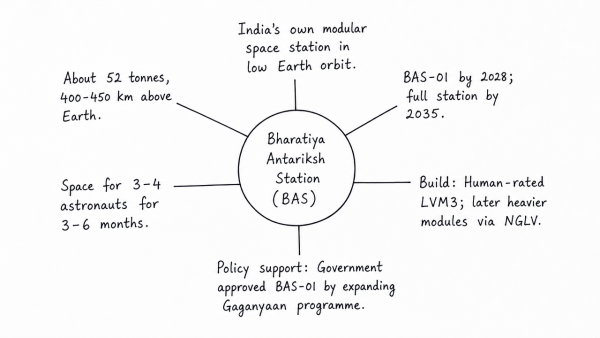
- What it will be like: About 52 tonnes, 400–450 km above Earth, with space for 3–4 astronauts for 3–6 months.
- How it will be built: It will use the human-rated LVM3 initially, and later heavier modules may use the Next Generation Launch Vehicle.
- Policy support: The government has approved BAS-01 by expanding the Gaganyaan programme.
Benefits to India’s space programme:
- Enables long-duration human spaceflight beyond Gaganyaan.
- Provides a permanent lab for microgravity research in medicine, materials and pharma.
- Builds key skills in docking, life-support, robotics and station assembly.
- Strengthens the private sector and India’s strategic autonomy in space.
Overall, BAS will make India a stronger space power and prepare it for future deep-space missions, including lunar exploration.
Originally written on
September 1, 2026
and last modified on
September 1, 2026.