‘The Supreme Court of India keeps a check on arbitrary power of the Parliament in amending the Constitution.’ Discuss critically. (UPSC 2013)
The Supreme Court acts as a constitutional sentinel by ensuring that Parliament’s amending power is not used to destroy the Constitution itself. Yet this control is not absolute; it is meant to preserve the Constitution’s identity, not to replace Parliament’s role.
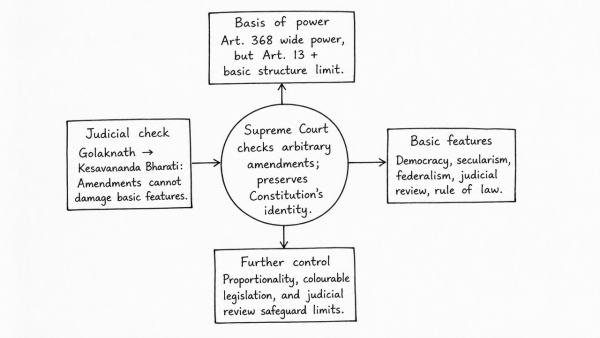
- Basis of power: Article 368 gives Parliament wide power to amend, but Article 13 and the basic structure doctrine impose limits.
- Judicial check: From Golaknath to Kesavananda Bharati, the Court held that amendments cannot damage basic features like democracy, secularism, federalism, judicial review and rule of law.
- Further control: In Minerva Mills and I.R. Coelho, the Court struck down attempts to make Parliament’s power unlimited and protected review of Ninth Schedule laws.
Critically, this doctrine is sometimes attacked as vague and undemocratic because “basic structure” is not exhaustively defined. However, without such a check, a transient majority could amend away rights and institutions. Thus, the Supreme Court keeps a necessary, though contested, check on arbitrary constitutional amendment power.
Originally written on
August 28, 2026
and last modified on
September 7, 2026.