Point out why pest resistance has compromised genetic cotton traits in India. How can non-transgenic high-density planting systems overcome these recurring biotechnology challenges?
Pest resistance has weakened the promise of genetically modified cotton in India, especially against pink bollworm. Overdependence on long-duration Bt hybrids and weak refuge compliance have sped up resistance, while Bt toxin expression also falls in older plants.
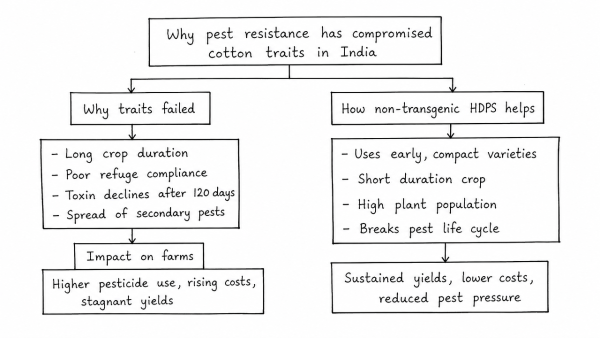
- Why traits failed: BG-I started failing against pink bollworm in 2009 and BG-II by 2014.
- Systemic factors: long crop duration, poor refuge planting, declining toxin levels after 110-120 days, and spread of secondary pests.
- Farm impact: higher pesticide use, rising costs, and stagnant yields.
How non-transgenic HDPS helps:
- Uses compact, early-maturing varieties, cutting crop duration and helping the crop escape late pink bollworm attack.
- Raises plant population per hectare, improving productivity without Bt dependence.
- Fits mechanised sowing, spraying and harvesting, reducing labour costs.
- Supports IPM through traps, biopesticides and cultural control, slowing resistance build-up.
Thus, non-transgenic high-density planting offers a more resilient and sustainable cotton system, combining higher output with lower pest pressure and less biotech risk.
Originally written on
June 30, 2026
and last modified on
September 17, 2026.