Point out the key bottlenecks in India’s cold chain logistics. How can integrated cold chains prevent post-harvest losses in perishable horticulture? Discuss.
India’s cold-chain challenge is not merely a shortage of cold stores; it is the absence of reliable links from farms to markets. This weakens quality, farmer returns and food security, especially for highly perishable horticultural produce.
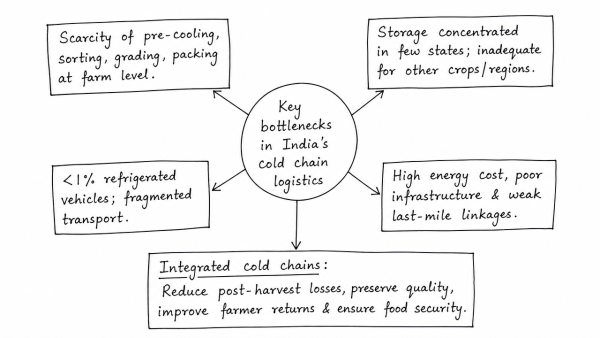
Key bottlenecks
- First-mile facilities for pre-cooling, sorting, grading and packing are scarce, so produce is damaged or deteriorates before reaching storage.
- Although storage capacity is substantial, much serves potatoes and is concentrated in a few states; facilities for other crops and producing regions remain inadequate.
- Under 1% of goods vehicles are refrigerated, while fragmented operators, high energy costs and unreliable power make temperature control expensive.
- Mandis often lack handling and storage facilities; weak market information and limited processing further restrict timely sale and value addition.
How integrated cold chains reduce losses
- Pre-cooling at farm gates removes field heat; nearby pack-houses enable sorting, grading and packaging, reducing bruising and microbial decay.
- Continuous, crop-appropriate temperature and humidity—from storage through reefer transport, processing and retail—prevent cold-chain breaks and extend shelf life.
- Multi-product hubs near production clusters can connect farmers to processors and urban markets; pulping, drying, freezing or irradiation can absorb surplus and convert lower-grade produce into saleable goods.
- Digital sensors and traceability flag temperature breaches, while demand forecasts improve stock rotation and dispatch.
- FPO-led aggregation and market links strengthen bargaining power and reduce distress sales.
Public support should prioritise gaps, renewable energy and scheme delivery, alongside finance and standards. Integrated networks can cut waste, stabilise supplies, raise farmer incomes and remain accessible to smallholders.
Originally written on
October 9, 2026
and last modified on
October 7, 2026.