India is well endowed with fresh water resources. Critically examine why it still suffers from water scarcity. (UPSC 2015)
India is rich in water in absolute terms, but scarcity arises because availability is uneven, seasonal and increasingly polluted. The real problem is not only how much water exists, but how much can be stored, shared and kept fit for use.
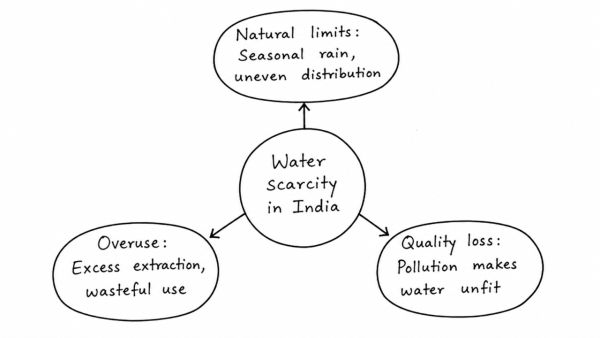
- Natural limits: Most rain falls in a short monsoon window, so runoff is high but storage is low. Many regions face drought even while others have floods.
- Overuse: Groundwater is heavily pumped for irrigation and cities. Water-intensive crops in dry regions and cheap power encourage wasteful use.
- Quality loss: Sewage, industrial effluents, farm chemicals and arsenic or fluoride pollution make large volumes unsafe, shrinking usable supply.
- Governance gaps: Weak regulation, poor river-basin planning, leakage, low reuse and interstate disputes worsen the crisis.
Thus, India’s water scarcity is largely a crisis of management, equity and quality, not merely of physical abundance. A shift towards conservation, crop diversification, wastewater reuse and stronger basin-level governance is essential.
Originally written on
August 30, 2026
and last modified on
August 30, 2026.