How far is Integrated Farming System (IFS) helpful in sustaining agricultural production? (UPSC 2019)
Integrated Farming System (IFS) is highly helpful in sustaining agricultural production because it links crops, livestock, poultry, fish, forestry and allied activities on one farm. It reduces risk, recycles resources and gives farmers regular income through diversified outputs.
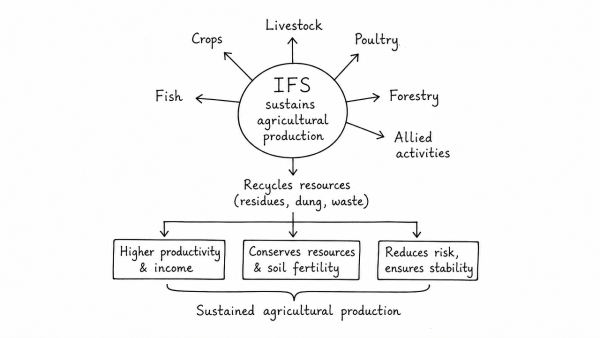
- Productivity and income: By using crop residues, dung and farm waste as inputs, IFS lowers input cost and improves net returns. It also gives year-round cash flow, unlike seasonal monocropping.
- Resource conservation: Recycling of nutrients through compost, biogas slurry and vermicompost improves soil fertility, water use efficiency and farm resilience.
- Risk management: If one enterprise fails due to drought, pests or price fall, others can support household income and food security.
- Climate resilience: Diversified systems are better suited to rainfed and fragile क्षेत्रों, where weather shocks are frequent.
However, IFS needs credit, training, labour and market support. Thus, it is not a complete substitute for better infrastructure, but it is a strong pathway to sustainable and stable agricultural production.
Originally written on
September 1, 2026
and last modified on
September 1, 2026.