How do solid-state batteries resolve the safety and energy density limitations of conventional lithium-ion technologies? Critically examine the technical challenges hindering their large-scale commercialization.
Solid-state batteries replace the flammable liquid electrolyte of conventional lithium-ion cells with a solid ion-conducting material. This change can greatly improve safety and also allow higher energy storage in a smaller, lighter cell.
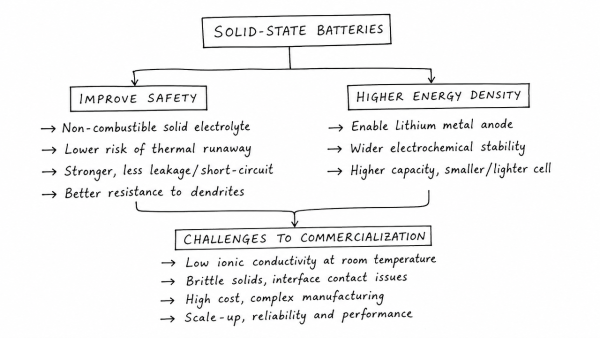
- How they improve safety
- They remove the main fire hazard: volatile organic liquid electrolyte.
- The solid electrolyte is non-combustible and more thermally stable, so the risk of thermal runaway is lower.
- Better mechanical strength reduces leakage and short-circuit risk after puncture or damage.
- Many designs also offer improved resistance to lithium dendrite penetration.
- How they raise energy density
- They can use lithium metal anodes, which store far more charge than graphite anodes.
- The solid electrolyte can also act as separator, reducing inactive material and weight.
- In theory, this can deliver 50-80% higher energy density and longer driving range for electric vehicles.
- Technical hurdles
- High interfacial resistance: Solid-solid contact is poor, especially as electrodes expand and contract during cycling.
- Dendrites still persist: Lithium can still grow through defects under high current or repeated use.
- Manufacturing difficulty: Producing thin, defect-free solid layers at scale is complex and costly.
- Stack pressure needs: Many cells need constant pressure, complicating pack design.
- Durability and cost: Cycle life, low-temperature performance and mass-production economics remain unresolved.
Thus, solid-state batteries promise a safer and more energy-dense future than conventional lithium-ion technology, but large-scale commercial use will depend on solving interface, manufacturing and cost challenges. Until then, they are likely to remain limited to niche and premium applications.
Originally written on
September 19, 2026
and last modified on
September 19, 2026.