How can India balance maritime security cooperation with USINDOPACOM while preserving strategic autonomy in the Indo-Pacific? Critically analyse the security challenges involved.
India can deepen maritime security cooperation with USINDOPACOM without entering a formal alliance by keeping the partnership issue-based, capability-driven and transparent. The aim should be to strengthen deterrence, surveillance and HADR while retaining independent decision-making in all theatres.
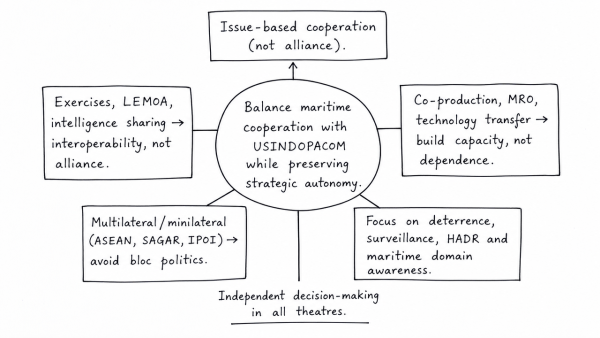
- How India can balance cooperation:
- Use exercises such as Malabar, logistics pacts and intelligence sharing for interoperability, not alliance commitments.
- Expand co-production, MRO and technology transfer so gains build Indian capacity, not dependence.
- Prefer multilateral and minilateral frameworks with ASEAN centrality, SAGAR and IPOI to avoid bloc politics.
- Keep cooperation focused on piracy, IUU fishing, drug trafficking, HADR and maritime domain awareness.
- Maintain parallel ties with Russia, Europe, the Gulf and the Indian Ocean neighbours to preserve strategic choice.
- Security challenges:
- China’s growing naval presence, grey-zone tactics and pressure in the South China Sea and Indian Ocean.
- Risk of being drawn into US-China rivalry over Taiwan or freedom of navigation operations.
- Dependence on US-origin platforms and data links may create vulnerabilities in crisis.
- Cyber threats, sabotage of subsea cables, piracy and trafficking remain serious non-traditional risks.
- Regional states may read closer India-US cooperation as bloc formation, complicating India’s outreach.
India should therefore pursue selective convergence, not strategic subordination. A strong navy, diversified partnerships and a clear autonomous doctrine can allow India to shape an open Indo-Pacific while avoiding entrapment in great power rivalry.
Originally written on
October 7, 2026
and last modified on
October 7, 2026.