Explain why Sustainable Aviation Fuel (SAF) is categorized as a ‘drop-in’ fuel. How does its lifecycle emission profile differ from conventional ATF?
Sustainable Aviation Fuel (SAF) is called a drop-in fuel because it can be used in existing aircraft engines, fuel systems and airport infrastructure without any design change. It is chemically very similar to conventional Aviation Turbine Fuel (ATF) and is approved under strict standards such as ASTM D7566 before blending for commercial use.
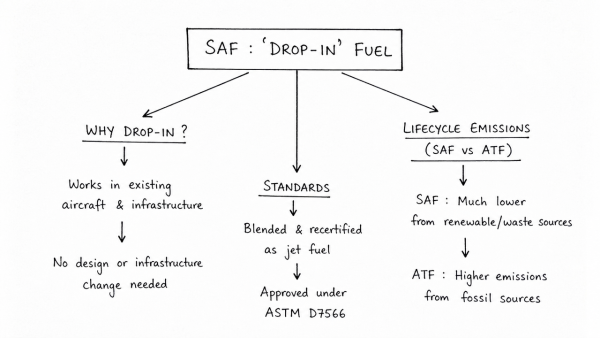
- Why drop-in: compatible with current aircraft and supply chains.
- Standards: SAF is blended and then recertified for use as jet fuel.
Its lifecycle emissions are much lower than ATF because SAF is made from renewable or waste feedstocks such as used cooking oil, biomass residues or captured carbon, instead of fossil crude. The carbon released on burning is largely part of a short carbon cycle, not newly extracted fossil carbon.
- Emission gain: up to about 80% lower lifecycle GHG emissions, depending on pathway.
- Co-benefits: lower sulfur and aromatics can cut soot, SOx and contrail impacts.
Thus, SAF can reduce aviation’s climate footprint without disrupting existing operations.
Originally written on
September 4, 2026
and last modified on
October 1, 2026.