Explain the operational distinctions between tethered Remotely Operated Vehicles (ROVs) and Autonomous Underwater Vehicles (AUVs). How do they strategically enhance India’s deep-sea surveillance capabilities?
ROVs and AUVs extend human reach underwater, but differ in control, endurance and role. Together, they can strengthen India’s surveillance of maritime approaches and seabed assets.
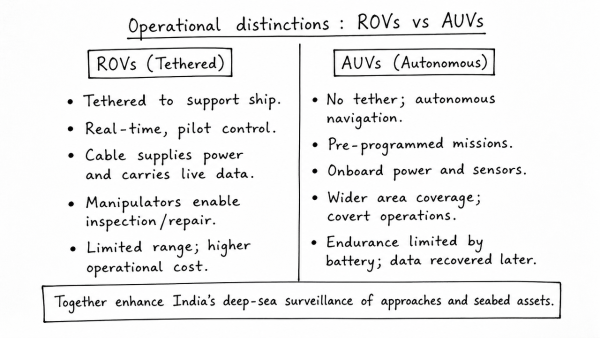
Operational distinctions
- ROVs are tethered to a support ship and piloted in real time. The cable supplies power and carries live data; manipulators enable close inspection or repair. Tether and vessel needs limit range and raise costs.
- AUVs navigate programmed missions without a tether, using onboard power and sensors. They cover wider areas covertly, but battery life limits endurance; data is generally recovered after retrieval.
Strategic contribution
- AUVs map seabeds, detect mines and support submarine surveillance; ROVs inspect suspicious contacts, cables and port facilities. Together, they improve maritime awareness, protect crews and advance the Deep Ocean Mission. Indigenous systems and secure communications safeguard sensitive data.
However, these platforms complement, rather than replace, ships, submarines and human analysis; reliable navigation and recovery remain essential for missions.
Originally written on
October 9, 2026
and last modified on
October 9, 2026.