Examine how traditional, fixed-allocation transboundary water treaties can be restructured into climate-resilient frameworks. What are the key geopolitical challenges in implementing such adaptive water diplomacy?
Traditional transboundary water treaties were framed for stable flows and fixed shares. Climate change has made such arrangements less workable, as river regimes now face droughts, floods, variable rainfall and rising demand. The answer lies in shifting from rigid allocation to adaptive, benefit-based cooperation.
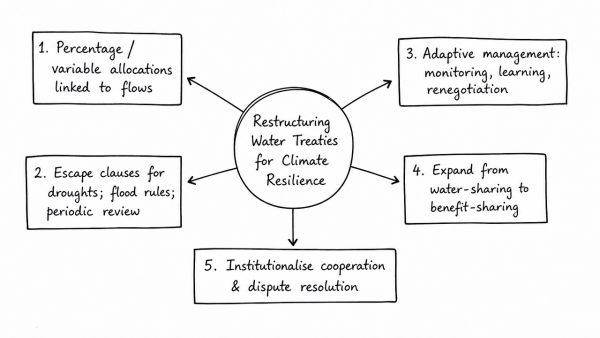
- How treaties can be restructured
- Move from fixed volumes to percentage-based or variable allocations linked to actual flow conditions.
- Include escape clauses for severe droughts, flood rules, and periodic review provisions.
- Adopt adaptive management with regular monitoring, learning and renegotiation.
- Expand from water-sharing to benefit-sharing through hydropower, flood control, navigation, ecosystem services and regional trade.
- Use integrated water resources management and the water-energy-food-ecosystem nexus to manage competing demands together.
- Create joint data systems, climate risk assessments, drought plans, flood forecasting and early warning mechanisms.
- Protect ecosystem flows explicitly, rather than treating nature as a residual user.
- Key geopolitical challenges
- Sovereignty concerns: States often resist any change seen as limiting control over “their” waters.
- Power asymmetry: Upstream states usually have greater leverage, while downstream states bear higher risk from reduced flows.
- Trust deficit: Suspicion over motives, enforcement and compliance weakens cooperation.
- Data sensitivity: Sharing hydrological data may be treated as a security issue, not a technical task.
- Unequal capacity: Poorer riparian states may lack finance, institutions and technical skills for adaptation.
- Domestic politics: Nationalist narratives, farming lobbies and energy interests can block compromise.
Adaptive water diplomacy is therefore not only a legal reform, but a political process of building trust, fair burden-sharing and joint resilience. The most durable treaties will be those that turn shared scarcity into shared security.
Originally written on
July 2, 2026
and last modified on
September 18, 2026.