Discuss the geopolitical and geostrategic importance of Maldives for India with a focus on global trade and energy flows. Further, also discuss how this relationship affects India’s maritime security and regional stability amidst international competition. (UPSC 2024)
Maldives, though small, occupies a strategic position in the central Indian Ocean, close to India’s western coast and astride key sea lanes linking the Gulf, the Strait of Hormuz and East Asia. Its location near the Eight Degree and One and a Half Degree channels makes it important for India’s trade and energy security.
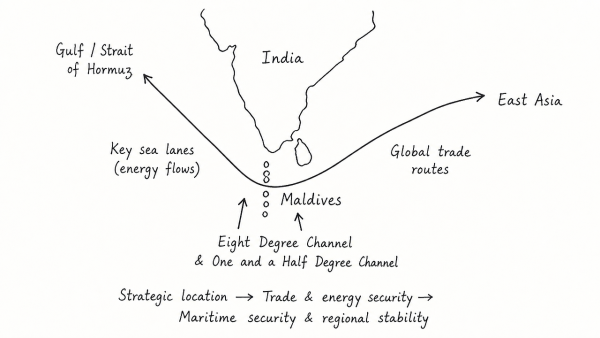
- Trade and energy flows: A substantial share of India’s external trade and hydrocarbon imports moves through these routes. Any disturbance in this arc can raise freight costs, disrupt supply chains and affect India’s energy prices and resilience.
- Maritime security: Cooperation with Maldives improves India’s maritime domain awareness through radar chains, coast guard coordination, joint patrols and information sharing. It helps counter piracy, illegal fishing, smuggling, trafficking and other non-traditional threats, while strengthening surveillance of the central Indian Ocean.
- Regional stability and competition: A stable Maldives supports order in the western Indian Ocean and enables India to act as a first responder during crises. At the same time, Maldives is a zone of strategic competition, especially with China’s expanding economic and infrastructure footprint, making Malé’s alignment crucial for preventing militarisation and preserving an open, rules-based Indian Ocean.
Thus, Maldives is a maritime pivot for India: it shapes trade and energy flows, reinforces India’s naval security and is vital for maintaining regional stability amid intensifying great-power rivalry.
Originally written on
September 4, 2026
and last modified on
September 4, 2026.