Discuss in the light of Indo-Nepal relations, how political challenges and delayed joint surveys impact transboundary water governance. Why is mutual bilateral cooperation essential?
Indo-Nepal water relations are shaped by shared rivers, but progress is often slowed by politics and mistrust. Transboundary water governance suffers when technical issues are treated as sovereignty disputes rather than common development challenges.
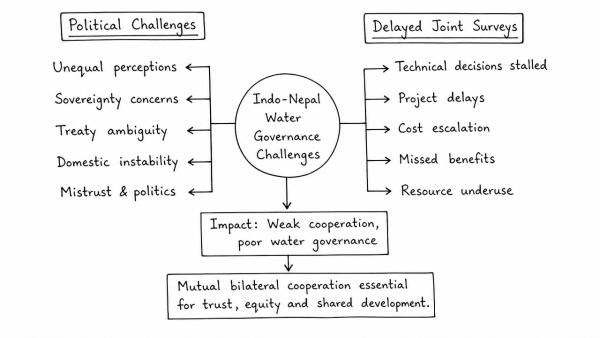
Political challenges
- Unequal perceptions: Nepal often views water projects as India-dominated, creating a “big-small country” mistrust.
- Sovereignty and border disputes: Concerns over control of river sources and unresolved issues like the Mahakali origin sharpen sensitivities.
- Treaty ambiguity: Agreements such as the Mahakali Treaty leave room for differing interpretations on benefit sharing and existing uses.
- Domestic instability: Frequent changes in Nepal’s politics weaken continuity in long-term water planning.
- Different priorities: Nepal seeks hydropower and export income, while India focuses on irrigation, flood control and downstream security.
Delayed joint surveys and their impact
- In projects like Pancheshwar and Saptakoshi, delays in joint surveys and DPR finalisation have kept key decisions pending for decades.
- This postpones benefit sharing, cost allocation, dam height decisions and rehabilitation planning.
- As a result, both countries lose hydropower, irrigation gains and flood moderation benefits.
- Delay also weakens trust, makes joint institutions ineffective and leaves Bihar and Nepal’s Terai exposed to recurring floods.
Why bilateral cooperation is essential
- Rivers from Nepal are vital to the Ganga basin, especially during the dry season.
- Cooperation can unlock clean power trade, better flood forecasting and climate resilience.
- Only joint planning can ensure equitable, efficient and politically acceptable use of shared waters.
Therefore, Indo-Nepal water governance needs trust-based, time-bound and technically driven cooperation. Mutual benefit, not unilateral advantage, is the only durable basis for managing shared rivers.
Originally written on
July 9, 2026
and last modified on
September 19, 2026.