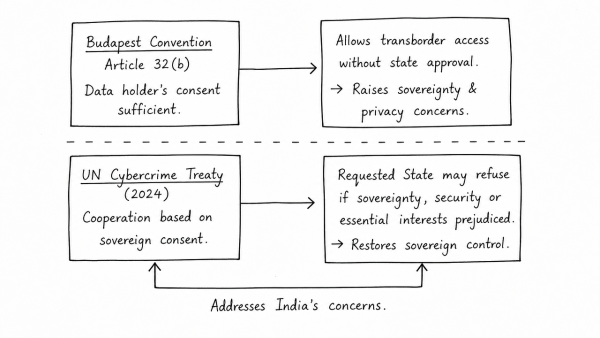
Critically examine how the UN Cybercrime Treaty’s emphasis on sovereign consent addresses India’s long-standing concerns regarding Article 32(b) of the Budapest Convention.
India’s objection to Article 32(b) of the Budapest Convention is that it permits transborder access to data, with the data holder’s consent, without approval of the state where it is stored. This raises territorial sovereignty and privacy concerns, as foreign agencies may bypass Indian law and safeguards. Response The UN Cybercrime Treaty (adopted in 2024) makes cooperation conditional on respect for sovereignty, security and essential interests. A requested state can refuse assistance where these are prejudiced, restoring the principle of sovereign consent that Article 32(b) was perceived to dilute. Its universal, UN-negotiated character also improves legitimacy for India, which was absent from Budapest’s drafting process. Gains India participated in negotiations, allowing it to press for domestic-law compatibility and human-rights protections. The treaty supports preservation and exchange of electronic evidence, a 24/7 assistance network and cooperation against serious cybercrime. Its privacy and proportionality orientation can complement the Puttaswamy judgment, Digital Personal Data Protection Act, 2023, Information Technology Act and existing Indian mechanisms such as I4C, CERT-In and the 1930 helpline. Limits Sovereignty clauses do not automatically prevent coercive requests, unilateral interpretations or politically motivated refusals. Vague offence definitions and uneven human-rights standards could facilitate surveillance or repression. The treaty is also not yet operational; its effectiveness depends on forty ratifications, national implementing legislation and trusted procedures for deciding refusals. India must therefore specify competent authorities, judicial oversight, data transfer rules and remedies. Thus, it better reconciles cooperation with India’s sovereignty concerns than Article 32(b), but safeguards depend on implementation.