Critically discuss how space diplomacy acts as an effective channel for sustaining international cooperation among rival nations during periods of intense geopolitical tensions.
Space diplomacy is the use of outer space cooperation, rules and dialogue to manage rivalry and avoid conflict on Earth. Even when ties between major powers are tense, it creates a practical space where states can keep talking, sharing data and coordinating conduct.
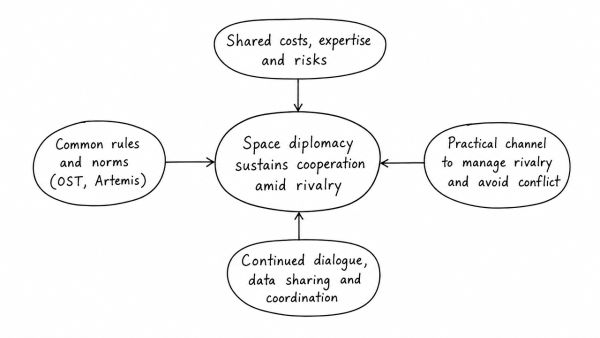
- Why it works: Space projects are costly, technically complex and risky. Rival nations often need pooled money, expertise and launch capacity, which encourages continued engagement.
- Institutional channels: The Outer Space Treaty and newer arrangements such as the Artemis Accords set broad norms on peaceful use, transparency and responsibility. Such frameworks reduce mistrust and offer predictable rules.
- Operational cooperation: Joint missions, frequency coordination, debris mitigation, cyber safety and data sharing require constant contact. The International Space Station shows that even adversaries can maintain cooperation when mutual dependence is high.
- Confidence-building value: Shared missions build habits of communication among scientists, engineers and astronauts. The Apollo-Soyuz mission and later multilateral projects showed how symbolic cooperation can ease wider tensions.
- Common global needs: Space-based services support weather forecasting, navigation, communication and disaster response. Problems such as orbital debris and space traffic management cannot be solved by one nation alone.
| Limitations | Space technologies are often dual-use. Export controls, strategic suspicion, anti-satellite weapons and competing blocs can weaken trust. Cooperation may continue only in narrow, technical areas while broader rivalry deepens. |
Thus, space diplomacy is not a cure for geopolitical conflict, but it is a rare and effective channel for keeping rival states engaged, reducing escalation risks and preserving rules-based cooperation. Its value lies in sustaining working relations where other diplomatic tracks may fail.
Originally written on
October 7, 2026
and last modified on
October 7, 2026.