Critically discuss how India can leverage its treaty-permitted run-of-river rights on western rivers to balance domestic energy needs and transboundary water diplomacy.
India’s western river rights under the Indus Waters Treaty offer a narrow but valuable space to meet clean energy needs without violating treaty limits. The challenge is to use these rights efficiently, while avoiding avoidable friction with Pakistan and preserving India’s long-term diplomatic credibility.
Why run-of-river matters
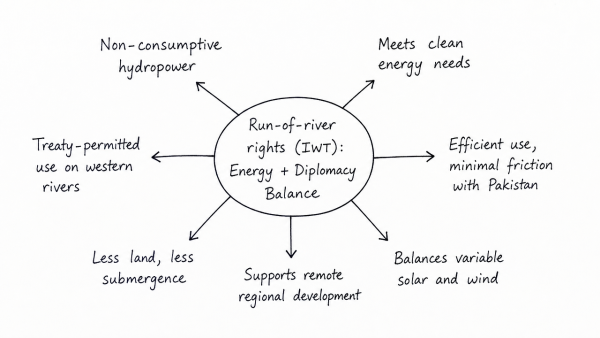
- India has limited use rights on the western rivers, but may pursue non-consumptive uses such as run-of-river hydropower.
- Such projects suit Himalayan terrain, need less land, cause less submergence, and support remote regional development.
- They also help balance variable solar and wind power, improve grid stability, and strengthen energy security.
How India can leverage these rights
- Speed up treaty-compliant projects such as Pakal Dul, Ratle and Kiru through faster clearances, financing and transmission planning.
- Prioritise small hydro and pumped storage, especially where terrain allows low-displacement generation and storage support.
- Use hydropower as part of a broader clean energy mix rather than as a sole source of base load power.
Diplomatic safeguards
- Strictly follow design limits on pondage, spillways and drawdown to reduce Pakistani objections.
- Strengthen the Permanent Indus Commission with timely data sharing on flows, design and operations.
- Frame projects as development and climate adaptation measures, not as coercive water instruments.
Critical concerns
- Over-securitisation of water can undermine trust and invite legal disputes.
- Climate change has made glacier and flow variability more uncertain, but the treaty offers limited flexibility.
- Delays in forest, environmental and right-of-way approvals weaken India’s own energy gains.
India should therefore pursue treaty-permitted hydropower with technical rigour, transparency and diplomatic restraint. This can support domestic energy transition while keeping water as a channel for cooperation, not confrontation.
Originally written on
May 21, 2026
and last modified on
September 11, 2026.