Critically discuss how geomagnetic solar storms impact satellite subsystems during the critical Launch and Early Orbit Phase (LEOP). What technological safeguards can mitigate such space weather risks?
Geomagnetic solar storms can seriously disturb satellites during Launch and Early Orbit Phase (LEOP), when orbit insertion, initial checkout and attitude stabilisation are still under way. The risk is high because the spacecraft has limited fuel margin, incomplete calibration and low tolerance for error.
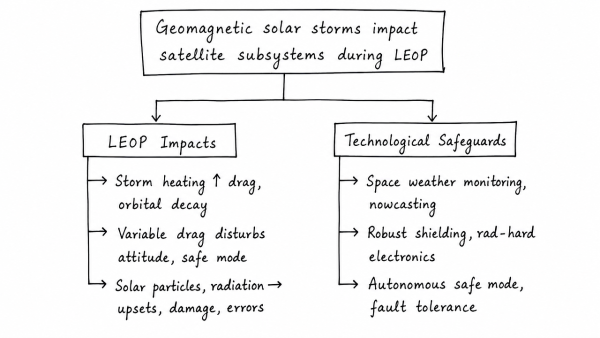
LEOP impacts
Storm heating expands the upper atmosphere, increasing drag in LEO, accelerating orbital decay and making orbit prediction unreliable. Variable drag and plasma conditions can disturb attitude, overload control systems and push the satellite into safe mode. Solar energetic particles and trapped radiation can cause bit flips, single-event upsets and permanent avionics damage. Surface and internal charging may trigger electrostatic discharge, affecting sensors and electronics. Ionospheric disturbance can also degrade GNSS accuracy, orbit determination and ground communication links.
Why LEOP is vulnerable
Orbit-raising margins are small, so extra drag can exhaust propulsion reserves. Tracking uncertainty increases collision risk, while early anomalies may be mistaken for launch or deployment faults, delaying recovery.
Safeguards
Radiation-hardened and shielded electronics, latch-up protection, redundancy in power and command paths, autonomous fault detection and safe modes, adaptive orbit models using real-time space-weather data, robust GNSS with multi-sensor fusion, and operational buffers such as delayed deployment, higher insertion orbits and storm-avoidance planning all reduce risk.
Thus, LEOP resilience depends on combining robust design, intelligent software and conservative operations with continuous space-weather monitoring.