Critically discuss how extreme space weather events pose a threat to global power grids and communication systems. What disaster mitigation protocols should India adopt to secure its infrastructure?
Extreme space weather, driven by solar flares, coronal mass ejections and geomagnetic storms, can damage both ground and space-based systems. Its danger lies in the fact that it is a natural hazard with global reach, yet modern infrastructure is deeply interconnected and highly vulnerable.
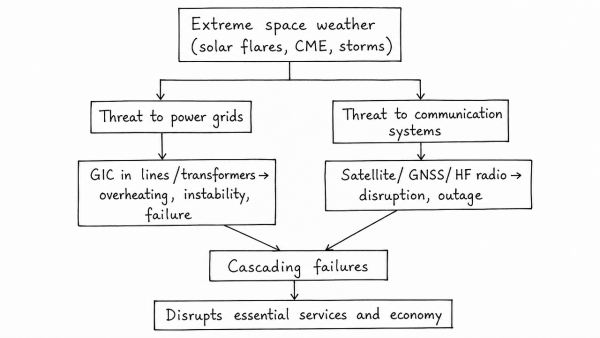
- Threat to power grids: Geomagnetic storms induce geomagnetically induced currents in long transmission lines and transformers. This can cause overheating, harmonic distortion, voltage instability and even permanent transformer failure.
- Cascading failures: A grid collapse can disrupt water supply, hospitals, transport, telecom towers and digital payments, turning a technical failure into a wider disaster.
- Threat to communication systems: Solar flares and energetic particles can cause HF radio blackouts, satellite electronics upsets, GPS and timing errors, and interruptions to aviation and maritime navigation.
- Systemic risk: The impact is not limited to one sector. Power, telecom, navigation and banking can fail together, increasing economic and security losses.
| India should adopt | Key protocols |
| Monitoring | Expand solar, ionospheric and geomagnetic monitoring through ISRO, IIG and warning centres; integrate forecasts into NDMA alerts. |
| Grid protection | Install GIC sensors, improve transformer cooling and insulation, use blocking devices, and prepare load-shedding and islanding plans. |
| Communication resilience | Ensure redundant links, satellite safe-mode protocols, resilient PNT systems and alternative communication for emergency services. |
| Governance | Frame a dedicated national space-weather policy, mandatory standards for critical infrastructure, and regular inter-agency drills. |
India must treat extreme space weather as a national security and disaster management issue. A forecast-led, multi-sector and standards-based approach will reduce damage, speed recovery and protect critical services.
Originally written on
September 12, 2026
and last modified on
September 12, 2026.