Critically discuss how ecological degradation accelerates zoonotic spillover of vector-borne pathogens. Explain why India needs a robust One Health framework to mitigate this risk.
Ecological degradation is now a direct driver of infectious disease risk. When forests are cleared, wetlands altered and climates destabilised, the buffers between wildlife, livestock and humans weaken, enabling vector-borne pathogens to spill over.
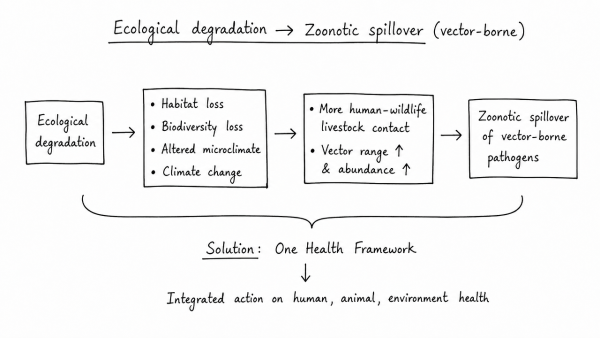
How degradation raises spillover
- Habitat loss pushes wildlife into farms, villages and peri-urban spaces, increasing contact with people and domestic animals.
- Biodiversity loss weakens the dilution effect, allowing competent hosts and vectors to sustain transmission.
- Changed microclimates after deforestation and urbanisation create warmer, wetter breeding sites for mosquitoes and ticks.
- Climate change speeds vector breeding and pathogen replication; floods and cyclones expand mosquito habitats.
- Land-use change and irrigation bring workers, livestock and vectors together, raising exposure to Japanese encephalitis, Kyasanur Forest disease and dengue.
Why India needs One Health
- High population density, large livestock populations, rich biodiversity and rapid land-use change make India highly vulnerable.
- Dengue, JE, KFD, scrub typhus and West Nile virus are expanding into new areas, showing changing disease ecology.
- Separate human, animal and environmental systems miss early warning signals and delay response.
India needs a robust One Health framework to integrate surveillance of humans, animals, vectors and ecosystems, enable shared data and joint response, and shift from reactive outbreak control to prevention and preparedness.
Originally written on
October 7, 2026
and last modified on
October 7, 2026.