Critically analyse why the adoption of dual-use technologies is critical for resource optimization in India’s aerospace sector. How can cybersecurity risks in such platforms be mitigated?
Dual-use technologies are critical for India’s aerospace sector because the same platform, component or software can serve both civilian and defence needs. In a capital-intensive sector with long gestation, they improve value for money, reduce import dependence and support Atmanirbhar Bharat.
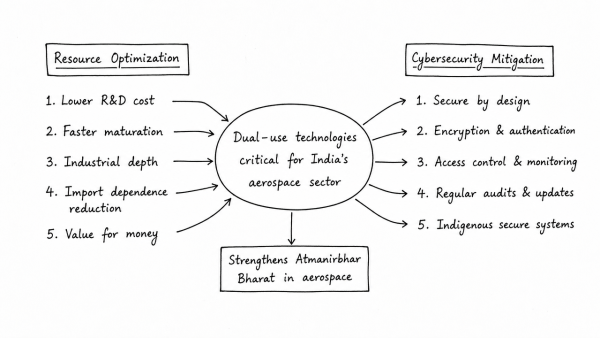
Resource optimisation
- Lower R&D cost: Commercial sensors, AI, navigation and communication tools can be adapted for defence instead of building parallel systems.
- Faster maturation: Civilian scale refines performance, while defence use tests reliability and resilience.
- Industrial depth: Start-ups, MSMEs and private firms can enter drones, avionics, satellite services and launch systems.
- Flexible capacity: The same manufacturing base can shift between civil and defence demand during crises.
- Export potential: Dual-use products widen markets and improve economies of scale.
Critical caveats
- Dependence on commercial supply chains can create security gaps.
- Rapid diffusion can enable misuse by hostile actors.
- Integrating civilian software into military systems may weaken mission assurance.
Cybersecurity mitigation
- Embed security-by-design in the earliest stage of development.
- Use encryption, access control, multi-factor authentication and least privilege.
- Mandate supply-chain audits, vendor verification and component traceability.
- Conduct vulnerability testing, patching, logging, monitoring and backups.
- Strengthen coordination among CERT-In, NCIIPC, regulators and defence agencies.
Thus, dual-use adoption is a strategic necessity for scale and self-reliance, but its gains endure only when cybersecurity is built into design, procurement, operations and supply chains.
Originally written on
September 16, 2026
and last modified on
October 3, 2026.