Critically analyse how the geomorphological mechanisms that trigger moraine-dam breaches in the Eastern Himalayas. How does climate-induced glacier retreat accelerate the frequency of such outburst events?
Moraine-dam outburst floods (GLOFs) occur when water stored behind unstable glacial debris escapes suddenly. In the Eastern Himalayas, steep relief, active tectonics and rapidly changing glaciers make failure a compound geomorphic and climatic hazard, rather than a single-trigger event. Geomorphological failure processes
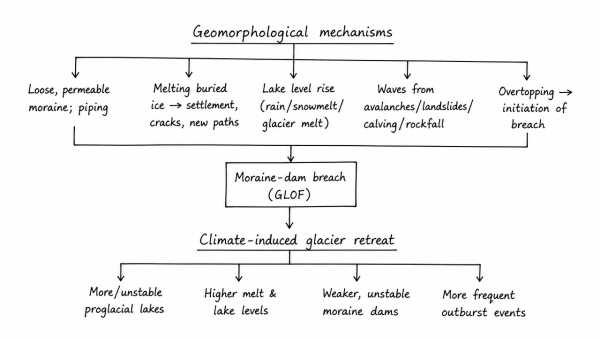
- Loose, poorly sorted moraine is weak and permeable; seepage can remove fines (piping), while melting buried ice causes settlement, cracks and new flow paths.
- Overtopping commonly initiates breach. Rain, snowmelt or glacier melt raises lake levels; avalanches, landslides, calving ice or rockfall may create waves that overtop the crest. Flow incises the debris, and headward erosion rapidly enlarges the breach.
- Earthquakes can fracture dams or trigger slope collapses into lakes, but failures usually reflect interacting stresses; identifying a single trigger is often difficult.
Climate-driven acceleration of outbursts
- Retreat exposes overdeepened basins and leaves moraine-dammed lakes; lake number, area and volume grow, increasing stored water and pressure on dams. Newly exposed, steep slopes lose ice support, while thawing permafrost and ice-cored moraines lose strength. Greater meltwater and more intense rainfall can push lakes towards overtopping, while avalanches create displacement waves. Thus warming raises both the probability of a trigger and the volume available to escape; it does not make every lake equally dangerous, since dam geometry, drainage and local geology govern risk.
Risk reduction therefore requires lake and dam mapping, ground and satellite monitoring, rainfall and seismic data, and community warning plans. Engineering interventions must be site-specific, as poorly designed works can transfer risk downstream or create instability.
Originally written on
November 2, 2026
and last modified on
November 2, 2026.