Analyse how the shift towards all-carbon composite structures in private launch vehicles optimizes fuel efficiency and payload delivery to Low Earth Orbits.
Private launch vehicles are increasingly using all-carbon composite structures to cut mass and improve orbital performance. In rocketry, every kilogram saved in dry weight reduces the propellant needed to reach the required delta-V for Low Earth Orbit.
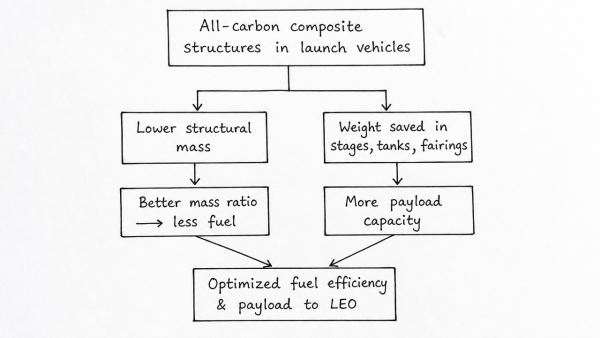
- Fuel efficiency: Carbon fibre composites are far lighter than aluminium and can be much stronger than steel. Lower structural mass improves the mass ratio, so the same engine thrust carries the vehicle further with less fuel.
- Payload gain: Weight saved in stages, tanks and fairings can be converted into extra payload capacity. Composite cryogenic tanks can also reduce structural weight by 28-41%.
- Design and reuse: High stiffness helps the vehicle withstand launch loads while allowing integrated, fewer-joint structures. This supports reusability, lower turnaround time and better economics for private firms.
However, high cost, inspection difficulty and cryogenic cracking remain challenges. Even so, all-carbon structures are a practical path to cheaper launches and higher payload delivery to LEO.
Originally written on
June 23, 2026
and last modified on
September 16, 2026.