Maharashtra FDA Sets Milk Supply Chain Safety Requirements
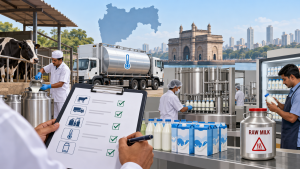
Maharashtra Food and Drug Administration Commissioner Tukaram Mundhe announced statewide food-safety requirements for the milk supply chain on 3 July 2026. The compliance order covers milk collection centres, dairy processing units, transporters, distributors, wholesalers and retailers.
Handling and traceability requirements
Stakeholders must maintain traceability records documenting milk’s movement from collection to final sale, maintain temperature control during transport and storage, and use food-grade equipment for handling milk.
Packaging, warnings and penalties
Pasteurised and other heat-treated milk must be sold in sealed, labelled and tamper-evident packaging. Raw-milk containers must be marked “RAW MILK” and carry a warning to boil the milk before consumption. Violations could attract penalties of up to ₹10 lakh or cancellation of a licence. The announcement concerned new requirements and compliance orders, not completed enforcement.
Important Facts for Exams
- Cold-chain continuity: A functioning cold chain depends on an uninterrupted sequence of refrigerated production, storage and distribution, supported by equipment and fleet management.
- Heat-treatment methods: Milk HTST pasteurisation typically uses 71.5°C for 15 seconds; UHT treatment uses 135°C for 1–2 seconds and, with special packaging, allows unrefrigerated storage.
- FSSAI statutory foundation: The Food Safety and Standards Act, 2006 established FSSAI and consolidated multiple earlier central food laws into a single statutory framework.
- Food recall notification: India’s Food Recall Procedure Regulations, 2017 require food businesses to initiate withdrawal of unsafe food and notify the competent food-safety authority.
| Related | |
|---|---|