Maharashtra Activates Rapid Medicine Screening
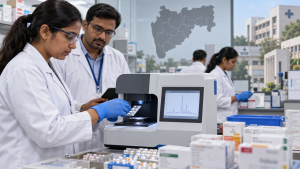
As of 26 October 2026, Maharashtra’s Public Health Department had activated drug-detection machines across the state’s eight divisions to conduct preliminary checks on medicines supplied to government health facilities. Public Health Minister Prakash Abitkar announced the initiative.
Screening and confirmation process
Using Raman-effect technology, each machine can screen a drug sample in two to three minutes. Suspicious or negative findings are to be sent to one of 12 government-approved external laboratories for confirmation. Sixteen trained officers, organised into two-member teams, have been assigned to the eight divisions. The teams must collect samples through monthly random checks at government health facilities, including district and women’s hospitals.
Cost and deployment
Each machine costs approximately ₹1.2 crore; the eight devices represent a total investment of ₹9.6 crore. Maharashtra is reported to be the first state in India to deploy this technology for medicine quality checks in its public health system.
Important Facts for Exams
- Inelastic scattering: Raman spectroscopy detects changes in photon energy when light interacts with molecular vibrations, phonons or other excitations.
- Molecular fingerprint: A Raman spectrum can act as a structural fingerprint, helping identify molecules from their characteristic vibrational information.
- Raman–infrared distinction: For vibrational analysis, Raman activity depends on a change in molecular polarizability; infrared activity requires a change in dipole moment.
| Related | |
|---|---|