Key Environmental and Forestry Laws and Policies
India’s environmental law framework rests on central statutes, constitutional principles and Supreme Court interpretations. For Prelims, the most important part is how recent amendments and court rulings have changed forest use, pollution control, biodiversity access and environmental clearance rules.
Forest Conservation and Land-Use Regimes
- Van (Sanrakshan Evam Samvardhan) Adhiniyam, 1980: In January 2026, the Ministry of Environment, Forest and Climate Change amended guidelines to treat certain plantation and afforestation activities on forest land as forestry activities rather than non-forest use.
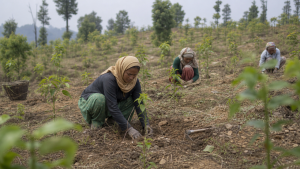
- Degraded forest land: The January 2026 guidelines exempt plantation and restoration work on degraded forest land from Compensatory Afforestation (CA) and Net Present Value (NPV) charges.
- Private participation: The revised approach allows state governments to involve private and non-governmental entities in ecological restoration efforts.
- Forest land lease: In December 2025, the Supreme Court held that forest land cannot be leased or used for agricultural or cultivation purposes without prior approval of the Central Government under Section 2 of the Forest (Conservation) Act, 1980.
- Broad definition of forest: In February 2024, the Supreme Court directed that the broad dictionary meaning of “forest” from the 1996 T.N. Godavarman ruling should continue to apply while petitions challenging the Forest Conservation Amendment Act, 2023 remain pending.
Pollution Control and Consent Guidelines
- Water (Prevention and Control of Pollution) Amendment Act, 2024: The amendment decriminalised several minor offences and replaced imprisonment with monetary penalties ranging from ₹10,000 to ₹15 lakh.
- Chairperson appointment: Under the 2024 amendment, the Central Government prescribes the nomination process and service conditions for State Pollution Control Board (SPCB) chairpersons.
- State adoption: The Water Amendment Act, 2024, which initially applied only to Himachal Pradesh, Rajasthan and Union Territories, was adopted by Haryana in September 2026.
- Uniform Consent Guidelines: In January 2026, the MoEFCC amended the consent framework under the Air Act, 1981 and the Water Act, 1974.
- CCA mechanism: The revised guidelines introduced a Consolidated Consent and Authorisation (CCA) mechanism.
- Consent to Operate: The Consent to Operate (CTO) is now valid until cancelled.
Biodiversity and Wildlife Legislation
- Biological Diversity (Amendment) Act, 2023: This Act came into force on 1 April 2024 and shifted India’s biodiversity access framework to a registration-based system.
- Certificate of Registration (CoR): A CoR from the National Biodiversity Authority (NBA) is required before applying for Intellectual Property Rights (IPR) based on Indian biological resources.
- Benefit-sharing rules: Under the Biological Diversity (Access to Biological Resources and Knowledge Associated Thereof and Fair and Equitable Sharing of Benefits) Regulation, 2025, approved in April 2025, benefit-sharing fees are linked to annual turnover.
- Exemption: Users of cultivated medicinal plants are exempt from the benefit-sharing fee structure.
- Wild Life (Protection) Amendment Bill, 2025: Introduced in the Rajya Sabha in December 2025, it proposed inserting Section 62AA to empower State Governments to declare animals as vermin.
Environmental Clearances and Constitutional Rights
- Vanashakti v. Union of India: In July 2026, a three-judge Supreme Court Bench prospectively quashed the Central Government’s 2021 Office Memorandum that allowed perpetual ex-post facto Environmental Clearances (ECs).
- Effect of ruling: The Court held that executive orders cannot dilute the prior EC requirements under the EIA Notification, 2006.
- Statutory power preserved: The Union Government may still use Section 3 of the Environment (Protection) Act, 1986 to notify time-bound, public interest-based amnesty schemes.
- Prospective effect: Existing ECs granted under the 2021 OM remain valid, and pending applications under the 2017 Notification or the 2021 OM are to be processed to their conclusion.
- Climate rights: In M.K. Ranjitsinh v. Union of India, the Supreme Court recognised the right to be free from the adverse impacts of climate change as part of Articles 21 and 14.
- Jojari River order: On 24 August 2026, the Supreme Court imposed an interim ban on construction within 100 metres of Rajasthan’s Jojari River and restricted hazardous activity near its flood line.
Key Prelims Takeaways
- Forest restoration: January 2026 guidelines treat selected plantation and afforestation work on forest land as forestry activity and exempt degraded forest land restoration from CA and NPV charges.
- Forest land use: Any lease or cultivation use of forest land still needs prior Central Government approval under Section 2 of the Forest (Conservation) Act, 1980.
- Water pollution law: The Water Amendment Act, 2024 replaces jail terms for several minor offences with civil penalties and centralises rules for SPCB chairpersons.
- Consent system: The 2026 consent framework introduces CCA and makes CTO valid until cancelled.
- Biodiversity access: From 1 April 2024, a CoR from the NBA is needed before filing IPR based on Indian biological resources.
- Environmental clearance: The Supreme Court has curtailed perpetual ex-post facto ECs while keeping existing valid clearances and allowing limited statutory amnesty schemes.
- Climate jurisprudence: The right to protection from climate change impacts has been read into Articles 14 and 21.
Current General Studies comprises current-affairs-based, General Studies-rich study material on policies, laws, institutions, economy, science, environment, governance, international relations, and other varied but important topics for UPSC and State PSC Prelims examinations.
Fortnightly PDF compilations: Available here
Originally written on
April 5, 2026
and last modified on
September 5, 2026.
| Related | |
|---|---|