Karnataka High Court Rules on Blood Samples under BNSS
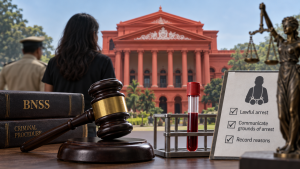
In April 2026, the Karnataka High Court quashed an FIR against a woman and set aside related medical and forensic reports, holding that a blood sample taken before her lawful arrest was inadmissible as evidence.
Court’s interpretation of Section 51
A single-judge bench of Justice M. Nagaprasanna interpreted Section 51 of the Bharatiya Nagarik Suraksha Sanhita (BNSS) as allowing a medical examination only after a lawful arrest. The court said collecting blood samples without such an arrest was impermissible and illegal. It also stressed that a lawful arrest requires compliance with statutory safeguards, including communicating the grounds of arrest and recording reasons.
Background to the case
The case arose from a birthday party raid in May 2025 at Ellavoma House in Devanahalli. The woman was one of 12 people booked for alleged drug consumption.
Important Facts for Exams
- Procedural code: The BNSS governs criminal procedure for administering substantive criminal law and replaced the Code of Criminal Procedure, 1973.
- Interrogation safeguard: The BNSS provides an accused person a right to a lawyer of choice during interrogation, but not throughout the interrogation.
- Electronic FIR procedure: BNSS section 173 allows information about a cognisable offence to be given irrespective of where it occurred; electronic submissions must be signed within three days.
- Arrest examination record: Under BNSS section 53, examination of an arrested person records injuries or marks of violence, and a copy is given to that person or their nominee.
| Related | |
|---|---|