Jhunjhunu Excavation Uncovers 11th–12th-Century Temple Remains
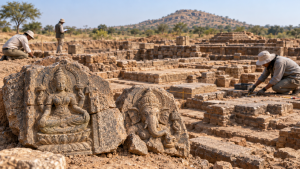
Archaeological excavation at Reerh ka Tila, near Tyonda village in Jhunjhunu district, Rajasthan, has uncovered structural remains of a temple preliminarily dated to the 11th–12th centuries.
Finds at the site
Fragments of images of Lakshmi and Ganesha were found, along with stone flooring, stone blocks and brick-built structures. These remains indicate a well-organised and grand temple complex.
Excavation work
The Rajasthan Department of Archaeology and Museums began scientific excavation on 1 January 2026, after surveying, demarcating and mapping the site. The department indicated that work would continue for approximately two more months, while artefacts are documented and conserved.
Important Facts for Exams
- Mandala plan: Hindu temple design often follows the vastu-purusha-mandala, a symmetrical, self-repeating plan shaped by cardinal directions, myths and mathematical principles.
- Sanctum and image: The garbha-griya is typically a small, enclosed, ornament-free square representing universal essence; the principal worshipped deity, or murti, is placed in or near it.
- Regional superstructure terms: Temple superstructures are called shikhara in northern India and vimana in southern India, reflecting a regional architectural distinction.
Originally written on
February 17, 2026
and last modified on
November 19, 2026.
| Related | |
|---|---|