Jharkhand High Court Orders FIR in Chaibasa HIV Case
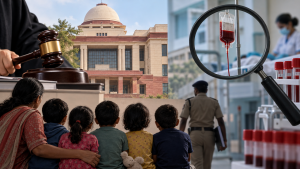
On February 4, 2026, the Jharkhand High Court directed police to immediately register a First Information Report (FIR) over five minor thalassemia patients who allegedly contracted HIV after blood transfusions at Chaibasa Sadar Hospital in West Singhbhum district.
Court orders investigation
Justice Gautam Kumar Choudhary issued the direction while hearing a writ petition filed on behalf of the children. The case began in October 2025, when the five patients, aged five to seven, tested positive for HIV after multiple transfusions at the hospital’s blood bank. Their families approached the court because no FIR had been registered. The court directed police to provide the complainants with a copy of the FIR and submit it to the court through a counter-affidavit. It also ordered a thorough, time-bound investigation into possible lapses in blood screening, storage or transfusion protocols and the fixing of responsibility.
Compensation challenged
The state government had announced ex gratia compensation of ₹2 lakh for each child. The petition argued that the amount was inadequate given the lifelong treatment required for both thalassemia and HIV.
Important Facts for Exams
- HIV donor-screening method: Nucleic acid testing (NAT) detects HIV genetic material in donated blood and can shorten the diagnostic window compared with antibody-based screening alone.
- Transfusion-related iron overload: Because the body has no active route for eliminating excess iron, repeated transfusions in thalassaemia can cause iron overload, managed with chelation therapy.
- Red-cell alloimmunisation: Repeated transfusions can induce red-cell alloantibodies; matching beyond ABO and RhD, particularly for Rh and Kell antigens, helps reduce alloimmunisation in transfusion-dependent thalassaemia.
- Mandatory FIR registration: In Lalita Kumari v Government of Uttar Pradesh, India’s Supreme Court held that police must register an FIR when information discloses a cognisable offence.
| Related | |
|---|---|