Jaldapara Expands Wildlife Monitoring and Forest Communications
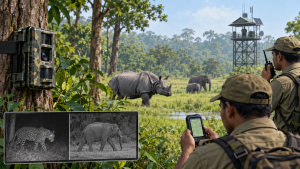
Jaldapara National Park in West Bengal has installed 210 double-sided camera traps across its approximately 216-square-kilometre area to improve wildlife monitoring and coordination among forest staff.
Wildlife monitoring
The park is divided into 105 grids, with two cameras in each. The cameras use infrared and white flash technology to capture still images and video in varying light conditions.
Forest communications
Modern GPS devices have been supplied to all forest beats, and radio telecommunication systems are active in more than 50 anti-poaching towers. A further 30 GSM-based, solar-powered live-relay cameras have been installed in elephant corridors and other critical areas for real-time surveillance.
Important Facts for Exams
- Camera-trap trigger mechanism: Infrared-triggered camera traps commonly use passive infrared sensors to detect changes in thermal radiation, rather than continuously recording their surroundings.
- GPS without mobile coverage: A handheld GPS receiver can calculate position from satellite signals without mobile-phone coverage, although dense canopy may impair satellite reception.
- VHF radio relays: In VHF radio networks, signals generally rely on line-of-sight propagation; strategically placed repeaters can bridge terrain-obstructed links.
- Elephant corridor connectivity: Elephant corridors connect larger habitat blocks, and their usefulness depends on keeping routes permeable rather than simply recording them on maps.
Originally written on
January 3, 2026
and last modified on
November 19, 2026.
| Related | |
|---|---|