India Bans Export of Black Mass Battery Waste
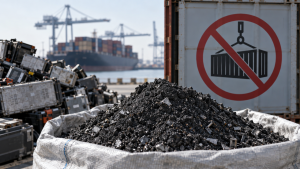
On 10 November 2026, the Directorate General of Foreign Trade (DGFT), under the Ministry of Commerce and Industry, prohibited the export of lithium-ion battery black mass with immediate effect. Notification No. 49/2026-27 changed the export policy for black mass under ITC (HS) Code 85491400 from “Free” to “Prohibited” until further orders.
Scope and objectives of the export ban
The prohibition covers unsorted waste and scrap of primary cells, primary batteries and electric accumulators, including spent cells and batteries that do not contain lead, cadmium or mercury. Black mass is a powder-like material produced by shredding discarded lithium-ion batteries and manufacturing waste; it contains minerals such as lithium, cobalt and nickel. The government aims to retain this material for domestic recycling, improve critical-mineral recovery and support clean-energy and electric-vehicle supply chains. The measure also addresses shortages of raw material faced by India’s battery recyclers. A ₹1,500 crore Incentive Scheme for Promotion of Critical Mineral Recycling, approved in September 2025, is part of related efforts to develop domestic capacity.
Waste-management requirements
The Ministry of Environment, Forest and Climate Change has classified black mass as hazardous waste, for which import and export require permission under the Hazardous and Other Wastes (Management and Transboundary Movement) Rules, 2016. The Battery Waste Management Rules, 2022, amended in 2025, require producers to register with the Central Pollution Control Board (CPCB) and meet annual recycling targets. CPCB issued guidelines on black mass utilisation in January 2025 and July 2026.
Important Facts for Exams
- Statutory basis: The Directorate General of Foreign Trade’s legal mandate derives from the Foreign Trade (Development and Regulation) Act, 1992.
- Policy notification role: The Directorate General of Foreign Trade’s functions include notifying import-export policy changes for specified goods.
- Recycling certificate mechanism: Registered recyclers generate extended-producer-responsibility certificates according to verified quantities recycled; producers use purchased certificates to demonstrate compliance with annual obligations.
- Basel consent procedure: Under the Basel Convention, hazardous-waste exports use a prior-informed-consent procedure: importing and transit states must consent before covered shipments proceed.
| Related | |
|---|---|