IIT Jodhpur Develops Bio-Bricks and Agro-Plastic Blocks
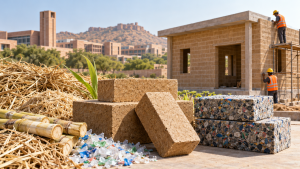
The Indian Institute of Technology Jodhpur in Rajasthan has developed next-generation bio-bricks and agro-plastic blocks for sustainable construction and the circular use of agricultural and plastic waste. The institute publicly detailed the innovation in April 2026.
Bio-brick technology
The patented technology was led by Dr. Priyabrata Rautray, an Assistant Professor at the institute’s School of Design, who also holds an Indian Bio-Bricks patent. The bio-bricks use agricultural residues including paddy straw, wheat straw and sugarcane bagasse. Their low-energy, lime-based production method does not require kiln firing, reducing greenhouse gas emissions. The materials are described as carbon-negative because they store more carbon dioxide over their lifecycle than is emitted during production.
Prototypes and construction
Built prototypes have demonstrated the materials’ practical feasibility, including a structure claimed to be India’s first bio-brick structure. A bio-brick-based housing unit was under construction at IIT Jodhpur in April 2026 to demonstrate the technology’s utility.
Important Facts for Exams
- Lime as masonry binder: Lime is commonly used as binding mortar in masonry because its adhesive properties help join bricks and stones.
- Plant-fibre constituents: Cellulose, hemicellulose and lignin make up much of plant straw; these lignocellulosic constituents can reinforce composites, although fibre treatment affects bonding.
- Composite interface: In polymer composites, plant fibres are hydrophilic while many plastics are hydrophobic; coupling agents can improve interfacial adhesion and composite strength.
| Related | |
|---|---|