IIT Guwahati Develops Bacterial Process to Remove Lead
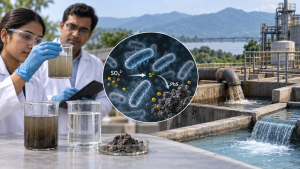
On 17 June 2026, researchers at IIT Guwahati in Assam announced a laboratory-stage biological process that uses naturally occurring bacteria to remove dissolved lead from acidic industrial wastewater.
How the process works
The process uses sulphate-reducing bacteria to convert sulphate in wastewater into sulphide. The sulphide reacts with dissolved lead to form lead sulphide, a solid that can be removed from the water. The treatment also reduces wastewater acidity, creating conditions more favourable for the bacteria. Compared with conventional chemical treatments, it produces less lead-containing sludge.
Research status and next steps
Leaching tests found that most lead in the bio-sludge was in stable forms, with only minimal amounts released—below regulatory limits for disposal in engineered municipal landfills. The findings were published in the Journal of Environmental Chemical Engineering. The research team comprises Professor Pranab Kumar Ghosh of the Department of Civil Engineering and research scholar Sreekanth Yadav Golla. Further work will examine low-cost carbon sources, reducing sulphide in treated water and possible metal recovery. The process requires further validation and is not yet ready for commercial or industrial deployment.
Important Facts for Exams
- Anaerobic respiration: Sulphate-reducing microorganisms use sulphate as the terminal electron acceptor in anaerobic respiration, reducing it to hydrogen sulphide.
- Dissimilatory reduction: In dissimilatory sulphate reduction, microorganisms reduce sulphate in large amounts to obtain energy and expel the resulting sulphide as waste.
- Precipitation reaction: Hydrogen sulphide or sulphide salts react with dissolved lead salts to produce a black lead sulphide precipitate.
| Related | |
|---|---|