IIT-BHU Develops Patented Wastewater Adsorbent
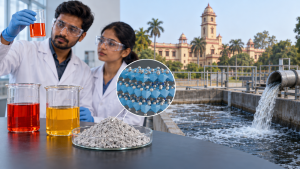
Researchers at the Indian Institute of Technology (Banaras Hindu University) (IIT-BHU) in Uttar Pradesh have developed a Layered Double Hydroxides (LDH)-based adsorbent to remove toxic dyes from industrial wastewater. The development was reported on 9 January 2026. The Government of India has granted patents for the material and its manufacturing method.
Performance and reuse
The adsorbent acts as a “chemical sponge” and removes 85% to 99% of pollutants including Congo Red and Methyl Orange. Depending on the nickel- or zinc-based metal combination, it can absorb up to 869.5 milligrams of dye per gram. Heating through calcination restores its effectiveness for up to 14 cycles. The estimated treatment cost is about 9 paise per litre.
Manufacturing method and research team
The method uses common metal nitrates and a controlled thermal process. IIT-BHU described it as practical, economically viable and environmentally friendly. The research and patent application involved Professor Chandan Upadhyay and Amit Bar of the School of Materials Science and Technology, and Dr Ram Sharan Singh of the Department of Chemical Engineering. The technology addresses dye pollution from textile, printing and pharmaceutical industries.
Important Facts for Exams
- Layer charge: Layered double hydroxides have positively charged metal-cation layers balanced by interlayer anions; neutral molecules such as water may also occupy those interlayers.
- Exchangeable interlayers: Layered double hydroxide interlayer anions are often weakly bound and exchangeable, supporting their use in ion-intercalation applications.
- Calcination: Calcination heats a solid compound without melting it and with restricted oxygen, commonly to remove volatile substances or induce thermal decomposition.
| Related | |
|---|---|