Hyderabad Surgeon Performs Remote Robotic Surgery from Wuhan
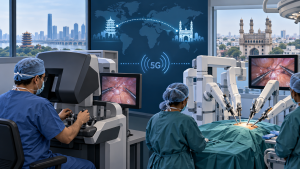
On 18 May 2026, Dr Syed Md. Ghouse, Director of Robotic and Minimal Access Urological Surgery at Hyderabad’s Asian Institute of Nephrology and Urology (AINU), performed a remote, robot-assisted ureteric reimplantation on a 57-year-old woman in Hyderabad.
Procedure and cross-border link
Dr Ghouse operated from Tongji Hospital in Wuhan, China, linking the hospitals across an approximate distance of 3,000 to 3,900 kilometres. The patient had recurrent ureteric obstruction caused by a lower ureteric stricture. Doctors and nurses in Hyderabad administered anaesthesia and positioned the robotic instruments.
Connectivity and duration
The operation used high-speed, low-latency connectivity leveraging 5G technology, with reported latency below 100 milliseconds. It was completed in about 90 minutes. Dr Ghouse and AINU described it as the world’s first tele-robotic ureteric reimplantation.
Important Facts for Exams
- System architecture: Remote surgery places surgeon and patient in different locations; its robotic system generally combines surgeon-controlled arms, a console and sensory feedback.
- On-site contingency: Remote robotic procedures still require an anaesthesiologist and backup surgeon on site in case communications fail or the robot malfunctions.
- Anti-reflux mechanism: In non-refluxing ureteric reimplantation, an oblique intramural tunnel through bladder muscle creates a flap-valve mechanism that limits backward urine flow.
- Reconstruction for longer defects: For longer distal ureteric defects, a psoas hitch mobilises the bladder; a Boari flap uses tubularised bladder wall to bridge the gap.
| Related | |
|---|---|